Google Ads

Thursday, January 28, 2010

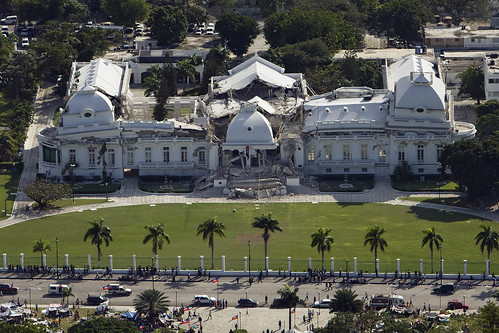
Haiti, without a palace too

Leticia Martínez Hernández


/PORT-AU-PRINCE, Haiti. — They say that only majestic place in the Haitian capital was its National Palace. The building, enormous and blindingly white, was yet another paradox in this country, immersed in abject poverty, but able to show off a palace in the style of the grand Petit Palais in Versailles.

History recounts that the National Palace took five years to be built, but it took barely one minute for it to be almost completely destroyed. The January 12 earthquake shook this Haitian national symbol mercilessly. This reporter went to the site and spoke with Fritz Longchamp, minister of the presidency, who was working together with his team in an improvised office in the shade of a tree.

Just a few hours after the tragedy struck, when the extent of the damage was not yet clear, everyone thought that, given the quake had affected the Palace so extensively, weaker buildings must have fared far worse. When our reporting team was visiting, even the helicopters flying overhead made the devastated walls shake.

Longchamp explained that the building’s three cupolas were destroyed; the left and center ones collapsed inward and the one on the right fell forward.

President René Préval’s office, the Council of Ministers room, the First Lady’s office and the meeting room were all buried when the roof collapsed. The central pavilion of columns was likewise demolished. During that collapse, at least four people were killed in the Palace’s central building, and another nine in the Presidential Guard headquarters, now virtually in ruins.

Thirty percent of the palace was destroyed, according to preliminary estimates. Longchamp said the proposal is to repair instead of demolish, because there are no structural problems.

“We would like to rebuild the cupolas, but this time, make them more earthquake-resistant.”

For that purpose, Haitian experts from the National Heritage Institute have been called upon to rebuild the Palace, together with Japanese and U.S. engineers and architects. They are currently assessing its structures and the patrimonial values that still remain among the debris.

The minister of the presidency, still sorrowful over the tragedy, emphasized that the Palace is very much a part of Haiti’s national identity, like its flag and shield.

Translated by Granma International

granma.cu


Tuesday, January 26, 2010

Careful planning is needed for Haiti's re-development


Haiti


By Youri Kemp:


The earthquake that hit Haiti earlier this year was a dreadful catastrophe that shook the conscience of every human being with a heart that beats in their body.

The comments made by certain quarters of the American political community and the religious community at large, are unwarranted.  They are unwarranted because the facts, as seen in the eyes of the persons who made them, are largely irrelevant to the issues at hand.   Gratuitously cruel to some extent.

The major, current issues are in finding ways for aid to reach Haitians in Haiti on the ground as well as what Haiti needs, in the form of development, to ensure that a catastrophe like this is not repeated.

We can surmise that no one can predict an earthquake with any certainty, even though scientists are becoming more accurate with their information.  However, Haiti won't miraculously move off of the plateau of the tectonic plates that caused the earthquake.  Also, Haiti would still need strong infrastructure and strong human services, to be able to better handle a catastrophe, like an earthquake, if a natural disaster happens again.

In a nutshell, considering the earthquake as well as the fact that Haiti is prone to hurricanes, Haiti needs to not only rebuild, but rebuild stronger, given the unnecessary loss of life that occurred.

Stronger building codes and a disaster management plan, is an obvious must.

Resetting the government agenda is also vitally important, but also an obvious must.

In addition, another issue that has arisen, more strongly post quake, is debt relief for Haiti. This, in conjunction with the almost bound to happen cry for reparations from France, are issues that have their merit grounded in historical and redistributive fact and need.

However, the question one must ask is: would spending money, via debt relief and reparations to and through the government of Haiti be worth its effort?  A government, which had its parliament collapse along with other government agencies, on top of the other issues as they relate to its fragile state before the quake (2008 mini-coup/riot that was quashed)?  Would this really work towards a better long term solution to the social, economic and political situation in Haiti?

I have my doubts on the viability of those options at this time. Perhaps it may be something to consider in the future of Haiti.

However, what about the underlying issues that has prevented Haiti moving, in the past, towards building a stronger, more progressive society?  A stronger, more progressive society, which would help to strengthen the people and the institutions of Haiti, in order for Haiti to sustain such a disaster -- God forbid, but more than likely, would happen again in light of the obvious realities.

Without going into a historical diatribe about the merits of any particular organisation, whether it was political or religious, the fact of the matter is that the distraction as it relates to the disruptions that were caused by political instability -- even if we speak to the heart and the socio-economic fibre of Haiti when we mention the name Duvalier, and the Voodoo belief system, which was seen to have propped up the dictator, is something that needs to sorted out, if Haiti is to become progressive.

Conventional wisdom, which in this case I will indulge because many indicators have shown that belief in this particular, even if one considers it axiomatic, position, is relevant; is the issue of the Haitian civil society and their private sector and the fact that they have been virtually non-existent in the past, if not, moribund, to say the most about it.

Civil society organisations have been proven to anchor communities and, by effect, stabilise communities through their organised nature and their ability to negotiate with business and political directorates and lobby for sensitive, effective and meaningful socio-economic solutions to critical issues.

Fostering a sense of common values, commitment and investment interests in the Haitian society, must never be repressed, ignored or uncultivated in the new Haitian society.

Where people have interests and investments’, coalescing around shared values on where the country is headed and what is needed to maintain sustained, positive development- issues as they relate to human and structural development, will be a synergistic, progressive positive.

The private sector must be engaged most vigorously. For the fact that the minimum wage in Haiti is, roughly, US$5 -- and we can imagine that most employers don't adhere to it -- is one that cannot be ignored and issues as they relate to (1) Curbing oligopolistic and monopolistic activity; (2) Providing for sustainable local markets; (3) Ensuring fair value in and access to external markets; and (4) Trade and development assistance from all the relevant partners and stakeholders in the global community, is a large task but must be essential for a new Haitian, country-wide progressive model.

Creating wealth in Haiti is an obvious task that must be addressed and attacked with full commitment from the Haitian government and their international partners.

The concerns as they relate to officials taking a mechanistic approach to the matter, is something that the Haitian government, non-governmental organisations and technical expertise from the development community -- bearing in mind the daunting task of country-wide buy in and creating economic synergies that are self sustaining -- must take in hand from a prejudiced standpoint of the status quo and assist their weaker partners, in that the civil society organisations.

Certainly, there are enough 'what to do's' to go about.  This author is not void of any.  However, what Haiti and its partners in assistance needs now is to identify which 'what to do' to target and work at it.  The second hardest part is 'how to do' as well as measuring the success of the 'what to do' as it would be and is impacted by the 'how did'?  This is obviously after immediate reconstruction and investment for that reconstruction.

Partners from around the globe must converge on Haiti and assist the society at large with whatever decisions are made. This includes not just assistance with debt relief -- if that be the case -- or development through trade or just supporting NGOs stationed in Haiti.

But, assist Haiti with the technical expertise to build a better nation, from the inside out.

January 26, 2010

caribbeannetnews

Monday, January 25, 2010

Traumatised Haitians struggle to comprehend grim fate

By Dave Clark:


PORT-AU-PRINCE, Haiti (AFP) -- It's not immediately clear where the crowd gathered in prayer ends and where the refugee encampment begins, as one group of listless, traumatised people bleeds into another.

With a symbol of state strength, Haiti's once magnificent National Palace, lying in ruins behind them, thousands left homeless by the devastating quake pin their hopes of salvation on God rather than on the works of man.

A woman prays during the funeral service for Haitian Archbishop Joseph Serge Miot who was killed in last week's devastating earthquake outside Notre Dame d'Assumption Cathedral in Port-au-Prince. AFP PHOTOThe reading is Psalm 102, and the reader has a high, clear voice, sometimes distorted by feedback through the massive rock concert-size speakers.

"Hear my prayer, O Lord, and let my cry come unto thee," she declares. "Hide not thy face from me in the day when I am in trouble; incline thine ear unto me: in the day when I call answer me speedily."

Worshippers in the crowd follow the text with their fingers in battered copies of the Bible salvaged from their demolished homes. In a break in the text their wavering voices sing along with a Misericordia prayer.

"For my days are consumed like smoke, and my bones are burned as an hearth," the Psalm continues. "My heart is smitten, and withered like grass; so that I forget to eat my bread."

"For I have eaten ashes like bread, and mingled my drink with weeping," runs the reading. "Because of thine indignation and thy wrath: for thou hast lifted me up, and cast me down."

Many Haitians were cast down on January 12, when a 7.0-magnitude quake tore into the capital and surrounding region, burying at least 112,000 people in the ruins of their shops and homes and leaving a million homeless.

Now the survivors are looking for sense among the senseless waste. A queue of them waits by the side of the stage as the reading continues.

One by one they take the microphone and loudly confess their sins and those of their people, begging the forgiveness of a God they can only suppose to have been so angered by Haitians that his wrath felled them in their thousands.

"My days are like a shadow that declineth; and I am withered like grass," the reader continues, her voice tireless. "But thou, O Lord, shall endure for ever; and thy remembrance unto all generations."

"He will regard the prayer of the destitute, and not despise their prayer. This shall be written for the generation to come: and the people which shall be created shall praise the Lord."

Not everyone in the crowd has come to pray, some are just bored by life in the tents and makeshift bivouacs carpeting the surrounding ceremonial square. others are here to do what business they can to survive.

A haggard-looking woman hawks a neat pile of freshly cleaned and pressed face towels. One optimist has erected a stall selling souvenir key rings with the Haitian flags and arm bands celebrating US President Barack Obama.

Elsewhere, family life continues. One woman huddles in a tiny patch of shade, breast-feeding an infant. Small boys wash in a bucket of soapy water while nearby their playmates fly kites made of wire and plastic waste.

Stands sell short sticks of sugar cane and small oily pastries.

Two young men unload French-language textbooks from a sack to sell on the kerbside. The cover boasts that readers will become fluent after a few easy lessons, but the salesmen themselves struggle to express themselves.

"What do I think of what happened? I don't think anything about it."

Across the road, marshalled by police with pump-action shotguns, a large but orderly and calm crowd presses around the door of a newly reopened bank, hoping to access cash, hoping that relatives abroad have sent donations.

"The cause of the quake was natural, but in what other country would it have had such an effect?" asks 33-year-old security guard Mercelus Luckner, fearful that he is unemployed after finding his firm's offices in ruins.

"Haitians have made many mistakes. They offended God. God is punishing us," he reasons, holding on to a vague hope that one of the foreign aid workers arriving in the city will pluck him from the crowd and offer him a job.

The Psalm ends: "Of old hast thou laid the foundation of the earth: and the heavens are the work of thy hands. They shall perish, but thou shalt endure:"

January 25, 2010

caribbeannetnews


Sunday, January 24, 2010

Help Haiti out of Haiti

Jamaicaobserver Editorial:


Centuries ago, the colonial powers of the western world executed a monstrous plan to transport millions of Africans across the Atlantic in the name of slavery. It was, in every sense of the word, a raw ride -- the Africans were shackled and crammed like sardines below the decks of the cargo ships -- which still makes for horrific reading.

Countless Africans succumbed to the disease and depression that accessorised the trip, jumping overboard to escape the unrelenting wretchedness which was every bit as heart-rending as what is going on in earthquake-devastated Haiti today.

But as long as the slave trade was profitable, no amount of suffering could undermine the objectives of its organisers. They needed free labour and they weren't about to let logistics, regard for human rights, or anything else get in the way of the transatlantic slave trade. On and on it went, for over 300 years, defying rebellion after rebellion, until the economics of it no longer made sense.

Even when slavery was completely abolished in 1838, the hard-fought-for freedom proved elusive for most, as the process of transitioning from a slave society to an emancipated one was far easier said than done.

The devil was in the detail.

Much as it is in Haiti where, according to several reports coming out of that country, people are dying of thirst and hunger within shouting distance of life-saving supplies.

According to one Associated Press (AP) report published in our Friday edition, General Douglas Fraser, head of the US Southern command that is running Haiti's airports, said 1,400 flights are on a waiting list for slots at the Port-au-Prince airport that can handle 120-140 flights per day. Further afield, artistes of international acclaim are releasing songs, more money is being collected and benefits are being staged... all in the name of helping Haiti.

We hate to appear cynical, or worse, ungrateful.

However, the fact is that even as the world comes up with scheme after scheme to help Haiti, the desperate earthquake survivors are running amok among the rubble, literally maddened by the stench of death and devastation.

According to one report, a 15-year-old girl was shot in the head while allegedly making off with two stolen pictures. What was going through her adolescent mind at the time is anyone's guess now.

Was she thinking of selling them for money to buy food?

If so, to whom?

Was she even aware of what she was doing?

Either way, it just doesn't make sense.

What people like this late young girl need more than all the entertainment, all the millions, in the world right now, is to be removed from the trauma that is Haiti. That's why those who can, have flocked to the shores, desperate to get out on the first thing smoking.

The survivors need a clean environment, compassion, food, a warm bed, medical aid and maybe a picture or two to give them a mental break, however brief, from the horrors of the past two weeks.

That just isn't available in Haiti at the moment, but it is in the countries that are tripping over themselves to help.

History tells us that with the will, evacuation would be a cinch.

Reality says otherwise.

January 24, 2010

jamaicaobserver

Saturday, January 23, 2010

The Haiti debacle

By Lloyd B Smith:


WONDER what is going through the minds of Jean-Claude Duvalier and Jean-Bertrand Aristide, the two exiled top honchos of Haiti? No doubt, both men would love to return at this time to their country which has been devastated by what has been described as that poverty-stricken country's worst earthquake in 200 years.

In the case of Jean-Claude Duvalier (Baby Doc), will his conscience sufficiently prick him to the extent where he will repatriate some of the many millions that he plundered from the public purse? Surely, he cannot return in the flesh lest he be numbered among the thousands of corpses in short order. Aristide, on the other hand, has a tremendous following but his return may well present a serious political dilemma for an already very confused state.

I don't know about my readers, but when I ponder the fact that Haiti is the poorest country in the Western Hemisphere that has now been hit by perhaps the worst natural disaster in living memory in the same region, one has to wonder if bad luck is worse than obeah (or is it voodoo?) Incidentally, it has been rumoured in Haiti that a high-ranking voodoo priest is responsible for this latest debacle because of an ungrateful people who made Aristide go. And here in Jamaica, there are the many cynics who maintain that the Haitians "wuk too much obeah (voodoo)", so that's why they received such a catastrophic visitation.

Be that as it may, the Haiti quake may well turn out in the long run to be a blessing in disguise for that most unfortunate country. Indeed, one cannot help but ask why, after all these decades during which Haiti has been ignored and despised, it is now being showered with so much aid, money and debt forgiveness? Isn't there some amount of hypocrisy involved here?

I must confess that I have become a bit sceptical about this massive outpouring of generosity and can only hope that most if not all that is being donated will in fact reach those thousands of suffering victims now bereft of just about everything except their miserable lives. In this vein, I must warn would-be donors to be wary of scammers and shysters who will use even this most tragic spectacle for self-aggrandisement. And please, don't just send "ole clothes" or personal effects that you have got tired of and were waiting to throw out, not to mention those expired foodstuff, including canned goods. The Haitians are poor and beleaguered, but they still have their dignity and self-respect.

In the meantime, what I find most interesting, if not intriguing, is the juxtaposition of the Jamaican "tax quake" which jolted us recently thanks to "Papa Bruce" and his team and that seismic wonder not too far from our shores. God-fearing Jamaicans are praising the Almighty for having spared us, because if it was us and not Haiti which had been so affected by that quake, then not even dog would want to eat our supper!

Despite the fact that Jamaica and Haiti are in the same fault line, we experienced only some minor shocks. But you know, I have to wonder if God is partial? After all, why should he bypass us and take on Haiti? Are we the preferred "children of Israel"? Whichever way one looks at this scenario, it is obvious that we are a very lucky country and Haiti, on the other hand, is a very unlucky place to live. Four hurricanes in one year battered that country, then this quake.

But while Jamaica has been spared the debilitating effects of natural disasters (acts of God), we have been subject to many acts of man such as our record number of murders. So let us not become too smug as if to say everything is coming up roses. Indeed, if all the promises and plans now being offered by the international community to Haiti should materialise, then Jamaica may well begin to compete for its current position - that of being the poorest country in the West!

It is good to see Jamaicans rising to the occasion in a bid to help our Haitian brothers and sisters in their distress. Our Prime Minister Bruce Golding has taken on the task of leading the charge on behalf of Caricom and this is most commendable, although he must be reminded that he still has his "quake back a yard" to deal with. In this context, we can only hope that Mr Golding does not become too comfy and distracted from his major task at hand - that of salvaging the Jamaican economy.

I am a bit worried about what I am hearing on the streets being spouted by gleeful Jamaica Labour Party supporters who feel that the Golding Cabinet pulled a fast one on the Jamaican public with respect to the tax package and the debt-management initiative. Against this background, Mr Golding needs to clarify whether the first tax package announced at the end of 2009 was a deliberate ploy to prepare the country for the debt-management initiative. There is talk that this was the only way to get the International Monetary Fund to soften its position while at the same time bullying the well-off who were benefiting so profusely from government paper to decide to share some of the burden. Is this a classic case of the politics of deception or expediency?

Meanwhile, there are many lessons to be learnt from the Haitian debacle, chief of which is what corruption can do to a country, including the needless loss of many human lives. More anon.

lloydbsmith@hotmail.com

January 19, 2010

jamaicaobserver


Disaster has a silver lining - an Obama Plan

By Franklin Johnston:


If you are poor you get sympathy; if you are "piss poor" you get help. Give thanks for Haiti! Jamaica's economic future is in the Greater Antilles, a market of 36m people (Haiti, Cuba, DR and us) and 5m in its diaspora - Air Jamaica can be viable with a 4m market. We live in 35 minutes of this large market yet are blind to our manifest destiny. Heaven is our backyard and we must build solid economic relations with our neighbours. Haiti's tragedy can be the spark to ignite our development and theirs.

We are powerless when faced with forces of nature. Despite the conspiracy theorists, Haitians are as good as people at the Vesuvius, Krakatoa or San Francisco disasters, just in the wrong place at the wrong time. Haiti is more sinned against than sinning, CNN cites the close bond with the US, but "the full has not been told". Still, 30-odd coups since independence killed more Haitians, only quietly. Their own leaders have bloody hands. Disasters have killed more in China than any nation, yet they flourish. Nature isn't angry, it's not God's retribution. The earth does what the earth does. If you live on an earth fault, expect a holocaust any time. You must move! Many died in the San Francisco quake and recent tsunami, did they move? No! We are flooded out, but rebuild on the same gully banks and bawl, pray, cuss the state and thank God for the cash after every flood. I am empty, but if you have tears, shed them! Soon, media fatigue will set in, the waters will close and Haiti will be as it was, but we can change tragedy to triumph. Think with me now:

*Dry your eyes and let's find the silver lining in this disaster. Can we mould a global flow of random donations into a structured plan for Haiti and the Caribbean? We won't spoil the spirit by reminding the US and France they owe Haiti. We can leverage this to get Haiti an economic makeover - an Obama Plan - as the US gave to Europe in the post-war Marshall Plan. To quote Shakespeare's As You Like It:

"Sweet are the uses of adversity

Which, like the toad, ugly and venomous

Wears yet a precious jewel in its head."

Europe got long-term US help and their economies soared. Bruce should lobby for an "Obama Plan" for Haiti.

*Would the UK, Italy, France, Germany do for Haiti and the Caribbean what the US did for them 65 years ago? Haiti is the poorest Western nation and the US president's troika and the West will deliver "big time"! But, what of the new money - Nigeria, Saudi Arabia, Iran, Dubai, Abu Dhabi - known for glitzy projects and obscene consumption? Let's see the generosity of Islamic states, Africa and Asia.

If Bruce and Portia get their minds around it, Haiti can be the sheet anchor of a Caribbean renaissance. Transport economics make the Greater Antilles our market. In our "salad days" we went to Miami for lunch on Fridays and got home for the nightly news. Cuba with 12m people, D R 11m, Haiti 10m, are our backyard! The geography imperative is incontrovertible and we ignore it to our peril. T&T draws close to its OECS neighbours as should we to ours. Fishermen trade with Haiti, as did the Tainos, and if they can cope in French and Spanish, so can we. Caricom neocons elevate English law and language and scorn economic reality. Thank God their tour to Haiti's ground zero, to clog the airspace, was thwarted. Caricom's bruised ego is not a topic Bruce should raise with Mrs Clinton. There are 92-plus agencies in Haiti on Phase 1 - first response aid and none toured before giving. Spoilt brats! Bruce and Portia should proffer a vision for Phase 5 - sustainable projects, to Hillary Clinton (the Marshall Plan was named after a secretary of state) and René Préval to be based on Caribbean enterprise and skills. Here is my list for our PM:

*An "Obama Plan" for Haiti and the Caribbean, funded by the Middle East, US, Europe, Asia, Africa to modernise transport, farming, manufacture, inter-island trade, exports and human capital; to use Caribbean skills and embed the know-how in the islands.

For Jamaica proper, Bruce and Portia must negotiate deals and facilities in Haiti for our Phase 4 "smart start" projects to benefit Haiti's market and ours. These include:

*Land for a Jamaica logistics park and entrepot for trade, manufacture and large-scale farming. A "recce" team to include Tony Hylton (ports, logistics); Peter McConnell, Jamaica Broilers (food farms); Grace (processing, distribution); Gassan Azan (trade goods); SRC and UWI/CARDI (yam, cassava, potato, tissue culture). The initial 13m-market enables high volume, low-cost production and import - big volume, small margins. Inter-island shuttle shipping will thrive and maritime and other jobs will open up on both shores.

*English has made us lazy. Let's learn French, Spanish, tackle the big markets in our backyard, build cross-border industry and let Caricom deliver what it can.

*Regional airlines and shipping in a market of 36m is feasible. Our commuter and private aircraft fleets will grow as some staff travel to work in Haiti, DR, etc.

*The UWI, UTech, NCU should give academic credits for field work and place 300

second-year students in a Caribbean Service Corps on a work-study track in social work, nursing, farming, construction, food tech, conservation, etc, projects as building and operating community bakeries. They should partner with Haiti's institutions.

* Our banks, money transfer, professional services firms, HEART/NTA must seek joint ventures. Haiti is close and can be treated as part of our internal market. Let's reach beyond our comfort levels and be brave for Haiti and for our own good.

*Our universities should team up with local consultants to bid on foreign-funded projects in Haiti and develop a portfolio of social and economic work.

We are rich compared to Haiti, so 5000 families should adopt a Haitian child for one year until they sort themselves out. One more mouth to feed is doable! We gain friends, have fun, free French lessons for the family and blessings galore! Stay conscious!

Dr Franklin Johnston is an international project manager with Teape-Johnston Consultants, currently on assignment in the UK.

franklinjohnston@hotmail.com

January 22, 2010

jamaicaobserver


Turning Guantanamo Bay into a point of light


Guantanamo Bay - Cuba


By Jean H Charles:


The American base at Guantanamo in Cuba, refitted to receive the enemy combatant prisoners and the terrorists of Iraq, Afghanistan and Yemen, is on the verge of being closed again due to negative publicity surrounding the alleged mistreatment of those prisoners.   Guantanamo Bay, with proper leadership and foresight, can reborn brightly as the most suitable place from critical care to recovery and rehabilitation for the Haitians victims of the devastating earthquake in a longer term.   It is at only half an hour from the town of Mole St Nicholas, Haiti where Christopher Columbus landed in the country five hundred years ago.

Those Haitians will return home later to a Haiti rebuilt and ready to receive them.   Guantanamo, with the leadership of the United States and financial support from the rest of the world, is a potential first response disaster relief and management center for the Western Hemisphere.   Fidel and Raul Castro, I am certain, would applaud such a move, causing a melting of the ice between the two governments, Cuba and the United States.   Such synergy is already in place in Leogane, Haiti, where Cuban and American doctors are working hand in hand in perfect harmony.


The vista of a young man with broken feet being discharged from the hospital with no one to receive him and no home to go to is disheartening at best.   Haiti after 1/12/10 needs a rehabilitation center for the thousand of discharged patients and halfway home for the thousand of orphaned children before adoption.   The situation in Haiti is similar to the fate of Europe after the defeat of the Nazis.   It took the leadership of a General John Marshall to transform the towns and the cities of France, Germany and England into vibrant entities.   It took also the leadership of General MacArthur in Asia to transform Japan into the power house of today.

Haiti, a pearl of the islands before its independence, was destined to become a ever-shining pearl after its gallant victory over slavery.   It has not been such.   This massive destruction will set Haiti years behind if no proper leadership is exhibited.   I share the concern of millions in the world, who wish Haiti well and would like to see its people enter into the kingdom of peace, harmony and welfare.

The state of the state of Haiti today is now one of confusion.   The United States has asked Canada and Brazil to join its administration in taking the lead for the reconstruction of Haiti, yet France and the European Community want to be major players in a country where French language and French mores are still queen.   Israel, Cuba, Venezuela and Turkey have been so far the most ready helpers.   The Dominican Republic is now setting itself to become the trustee of Haiti.

The Haitian government is nowhere to be found.   There was no better governance in the best of times. President Barack Obama has promised not to let the Haitians suffer alone in this difficult situation.   He will have to appoint a strong leader to lead the recovery, bring the sick, and the ones with broken limbs to Guantanamo, work with Europe and the other countries that want to devise a Marshall plan for Haiti and help instill in the country a sense of urgency, safety and solidarity of one towards the other.

One week after the earthquake, the excuses in the delay in breaking the bottleneck for essential delivery of health care to the people affected by the disaster are not reasonable.   The Haitian people once more have demonstrated their resilience, they know not to expect solace from their own government, they expect, though, a better coordination of leadership and logistics from the international community.

The Haitian government has paid the transportation for the refugees to return home to their ancestral towns.   It is planning tent cities on the outskirt of Port au Prince, against the grain of Haitian ethos that refuse to be refugees in their own country.   They need a hospitality center in each one of the small towns of Haiti to alleviate and organize the arrivals of the new residents.   A purse of a minimum of one million dollars in each one of the 150 towns of Haiti will go a long way in setting the stage for the reconstruction of Haiti and easing the pressure on the capital.

The power vacuum in Haiti on the national and international level is potentially as explosive as the recent earthquake:

– the political ballet dance of the United States not wanting to offend the Haitian government in taking charge of essential services,
– the United Nations wounded by the loss of its people and discredited for dismal performance for the last five years in Haiti,
– the rest of the international community already into a mode of a charity fatigue due to unnecessary bottleneck by those three players,
– the posturing of the major nonprofit organizations more interested in putting the spotlight on themselves instead of working together to bring essential services to the ordinary earthquake afflicted person.
– the Haitian government culture of treating its own citizens as pariah entities.

These are all the ingredients that will impede the speedy recovery of Haiti.   As the doctors and the nurses in the field who need essential tools and medication to save the sick and the wounded, as the community leaders in the slum documented by BBC, who provide better services for burying the dead, healing the sick, and feeding the hungry than the slow pace of the world armada camped at the airport still discussing logistics and protocol while Haitians are dying from post and non treatment.

I am crying for help, please! The ghost of Katrina is still haunting Haiti.

January 23, 2010

caribbeannetnews