Google Ads

Showing posts with label Venezuela. Show all posts

Saturday, May 23, 2026

Venezuela and the Perils of Ceding Sovereignty


US imperialism is “not to be trusted even a little bit,” much less considered a “partner” in a “cooperation agenda.” - Che Guevara


By Ricardo Vaz


The Overhauled Venezuelan Bolivarian Revolution

On January 3, the US bombed Venezuela’s capital region and kidnapped President Nicolás Maduro.  The unprecedented attack represented the culmination of a quarter-century of imperialist hybrid war, including devastating unilateral sanctions, mercenary incursions, “color revolution”-style insurrections, media disinformation, and NGO infiltration.

The four months since have brought a flurry of developments, from renewed diplomatic ties with the US to an overhaul of key legislative pillars of the Bolivarian Revolution.  Additionally, the Trump administration established semi-colonial control over Venezuelan oil revenues, with the amounts and timings of disbursements back to Caracas left entirely at US officials’ discretion.  The arrangement is similar to the one Washington has forced on Iraq since the 2003 invasion.

This compromised sovereignty is a catalyst for other issues.  On the one hand, it makes it tougher for the Venezuelan government to improve living standards without challenging business interests.  On the other, the burden of Venezuela’s external debt might see Washington attempt to impose an IMF loan that will bury the country in debt and dependency for decades.

The acting Rodríguez government’s tenure has been marked by accelerated political and economic transformations.  On the international front, Caracas has restored diplomatic ties with Washington and recently resumed dealings with the US-controlled International Monetary Fund (IMF) and World Bank.

Domestically, Rodríguez has changed key cabinet and military posts, while pushing through the National Assembly a number of reforms with the explicit goal of making the country more attractive for private sector investment, especially from Western multinationals.

Plans to reform pension, tax, housing, and the landmark 2012 labor law are in motion.  Mining and hydrocarbons have already undergone pro-business overhauls, with slashed fiscal responsibilities, decreased oversight, and disputes subjected to international arbitration.  In contrast to Chávez’s reassertion of oil sovereignty, which underpinned the massive sociopolitical achievements of the Bolivarian Revolution, the reformed energy law brings back the old concession model that puts operations and sales in the hands of private corporations.

In tandem, the Trump administration has issued licenses to pave the way for Western conglomerates to return to Venezuela, and several have already struck deals under the new highly favorable conditions.  The licenses maintain and even double down on US sanctions by barring dealings with China, Cuba, Iran, North Korea, and Russia and mandating that all Venezuelan state revenues from oil and mining be deposited in US Treasury-run accounts.

The subordination to US impositions saw Venezuelan authorities extradite former diplomatic envoy and minister Alex Saab to face charges in the US with little to no explanation.  The move was shocking but not out of context.  In recent weeks, there has been a succession of ceremonies at Miraflores presidential palace where Trump officials get the red-carpet welcome and escort corporate executives to sign contracts under the new pro-business incentives.  Far-right tech moguls, including Palantir founder Peter Thiel, are already taking advantage of Trump’s leverage to establish a lucrative foothold in the country.  For his part, the US chargé d’affaires holds regular publicized meetings with Venezuelan cabinet ministers. 

Caracas’ technocratic and pragmatic approach has dovetailed with a corresponding shift in discourse.  On foreign policy, the anti-imperialist rhetoric has all but vanished.  As Trump unleashes a savage war against Iran and threatens to “take over” Cuba, Venezuelan leaders have refrained from condemning the escalating imperialist aggression while emphasizing their desire to build good relations with Washington.  At the same time, references to Maduro have drastically decreased, as documented in a recent investigation.  Domestically, the central focus has become macroeconomic stability and attracting foreign investment.  Both Acting President Rodríguez and her brother, National Assembly President Jorge Rodríguez, acknowledged receiving “recommendations” and “suggestions” from oil majors amid the recent hydrocarbon overhaul. 

Rodríguez and the Bolivarian leadership, under ongoing US pressure, are betting that the pro-business opening will lead to accelerated economic growth that will trickle down into improved living conditions, thus allowing the government to rebuild social legitimacy and political prospects.  However, this plan faces serious roadblocks.

The first issue is that the acting authorities may not have a lot of time to improve the living conditions of the Venezuelan people. 

Over the previous seven years, with the economy asphyxiated by the US economic blockade, the Maduro government prioritized macroeconomic stability and reduced inflation first and foremost, through a strict monetarist policy package.  While the approach, coupled with a modest oil industry recovery, did lead to slowed down inflation and modest economic growth, it came at a price of freezing wages, consumer credit, and public spending.  The minimum wage, last raised in 2022, is now worth less than US $1 per month, with further increases replaced by non-wage bonuses that cheapen labor costs for employers.

Though these bonuses have increased periodically (the income floor is now $240/month for public sector workers), they are still far from covering living costs.  On May 1, Rodríguez ignored growing calls for a minimum wage hike, the conversion of bonuses to wages, and the restoration of collective bargaining rights, instead doubling down on the bonus policy.  With government officials announcing a labor reform soon, it is likely that the return of the minimum wage will come alongside a significant erosion of workers’ rights and employer responsibilities.

However, apart from its commitment to fiscal discipline, the Rodríguez acting government has little room to maneuver because of its lack of direct management over oil revenues.  At the mercy of the Trump administration to return export earnings in the amount and timing of its choosing, Venezuelan authorities are unlikely to commit to anything that might unsettle the budget.  Rodríguez herself warned that wage increases must be “responsible.”

There is a delicate balance to strike.  To implement the current pro-business agenda, not to mention the US rapprochement, the government needs social peace, and only improved material conditions for the working-class majority can ensure that in the short term.

It is not just the pressure for better living standards that looms large on Venezuela’s economic front.  There is a growing expectation that creditors will soon reengage with Venezuelan authorities to collect on a sizable external debt: a combination of defaulted bonds, unpaid loans, and arbitration awards that, with interest accrued over years, may amount to as much as $170 billion.  The Venezuelan government recently announced the launch of a debt restructuring process, while Washington issued a license allowing the hiring of financial and consulting services. 

Given the recent overtures to foreign capital, Venezuelan leaders will be hard-pressed to honor whatever commitments necessary to render the country a favorable investment climate.  Nevertheless, a major chunk of this debt is illegitimate.

On the one hand, debt ballooned in the mid-2010s as Venezuela’s credit rating was unjustifiably downgraded and borrowing costs went up, as Washington slapped its first rounds of sanctions on the Caribbean country.  The Maduro government made a strategic choice to prioritize debt service as the economy reeled following a collapse of global oil prices, hoping that this “discipline” would stave off a scenario where the country was shut out of financial markets.  It turned out differently.

Venezuela was gradually locked out of global finance after the Trump administration’s 2017 financial sanctions.  Bonds defaulted one after another and have been accruing interest ever since.  And the notoriously corrupt US-backed “interim government” also played its part in running up Venezuela’s liabilities and pilfering state assets abroad.

The diverse group of bondholders and corporations owed arbitration awards is sure to receive the backing of the White House, which holds the purse of Venezuela’s export proceeds.  This mechanism could be utilized to directly transfer Venezuelan state income to creditors in what would effectively amount to international wage garnishing.  Given how Venezuelan bonds have risen in recent months, investors are eagerly eyeing a significant windfall.

Venezuela’s unsustainable debt burden opens the door for further US imperial predations.  Even if there is an agreement to pay 50 cents on the dollar for Venezuela’s $170 billion debt for a period of 15 years, that comes to $5.6 billion a year, roughly a quarter of the present budget.  It is simply unpayable.

While Caracas may be able to settle with some creditors by privatizing Venezuelan state assets, it will not amount to much.  Venezuelan leaders will stress that, with the recent reforms and US opening, the economy will grow tremendously, and they will be able to honor all commitments.  But creditors are not willing to wait when they can cash in now, especially given Venezuela’s weak bargaining position.  The government cannot maintain a functioning country in the short term with a huge debt burden.  As a result, the US might take advantage of the crisis to impose a major loan from the IMF or some lending coalition.

An IMF or similar loan program is more than just an agreement to lend some amount under certain repayment conditions.  It is an opportunity to impose neocolonial arrangements on Global South countries.  In Venezuela’s case it is even more symbolic: it would mean exacting the proverbial pound of flesh for Chávez’s revolutionary audacity to challenge US hegemony in the Western hemisphere.

An eventual long-term credit program would surely come alongside a structural adjustment package of mass privatizations, gutted social expenditure, and all-around liberalization of the economy.  Given the current leverage over Venezuela, US officials may attempt to further entrench the rollback of the Caribbean nation’s sovereignty.

Between the growing domestic demands for improved living conditions and the specter of debt renegotiation, the acting Rodríguez government will find it increasingly difficult to walk the tightrope of maintaining social peace while continuing to make one concession after another to monopoly capital and the Trump White House. 

With the limits of US imperialism nakedly exposed in Iran, Trump needs a victory in Venezuela.  But that victory does not entail a buoyant economic recovery with social justice, let alone the survival of a sovereign and revolutionary project.  Victory for the US is a dependent country, mired in debt and underdevelopment, where Western corporations plunder natural resources and geopolitical rivals are kept at bay.

Ultimately, any long-term plan for sovereign development needs to start from the fact that US imperialism, to echo Che Guevara,  is “not to be trusted even a little bit,” much less considered a “partner” in a “cooperation agenda.”  It will undoubtedly be a major hill to climb.  But thankfully, even if it means starting over, the Bolivarian Revolution is not starting from scratch.

Source: Sovereign Media

Thursday, December 8, 2022

The arrival of Venezuelans seeking better lives has strained the economies—and societies—of Latin American host countries

Venezuela’s Migrants Bring Economic Opportunity to Latin America


By Marco Arena, Emilio Fernandez Corugedo, Jaime Guajardo, and Juan Francisco Yepez


By promptly integrating migrants, the economies of host countries stand to increase their GDP by as much as 4.5 percentage points by 2030


Venezuelan Migrants Instigate Latin America's largest migration episode in history
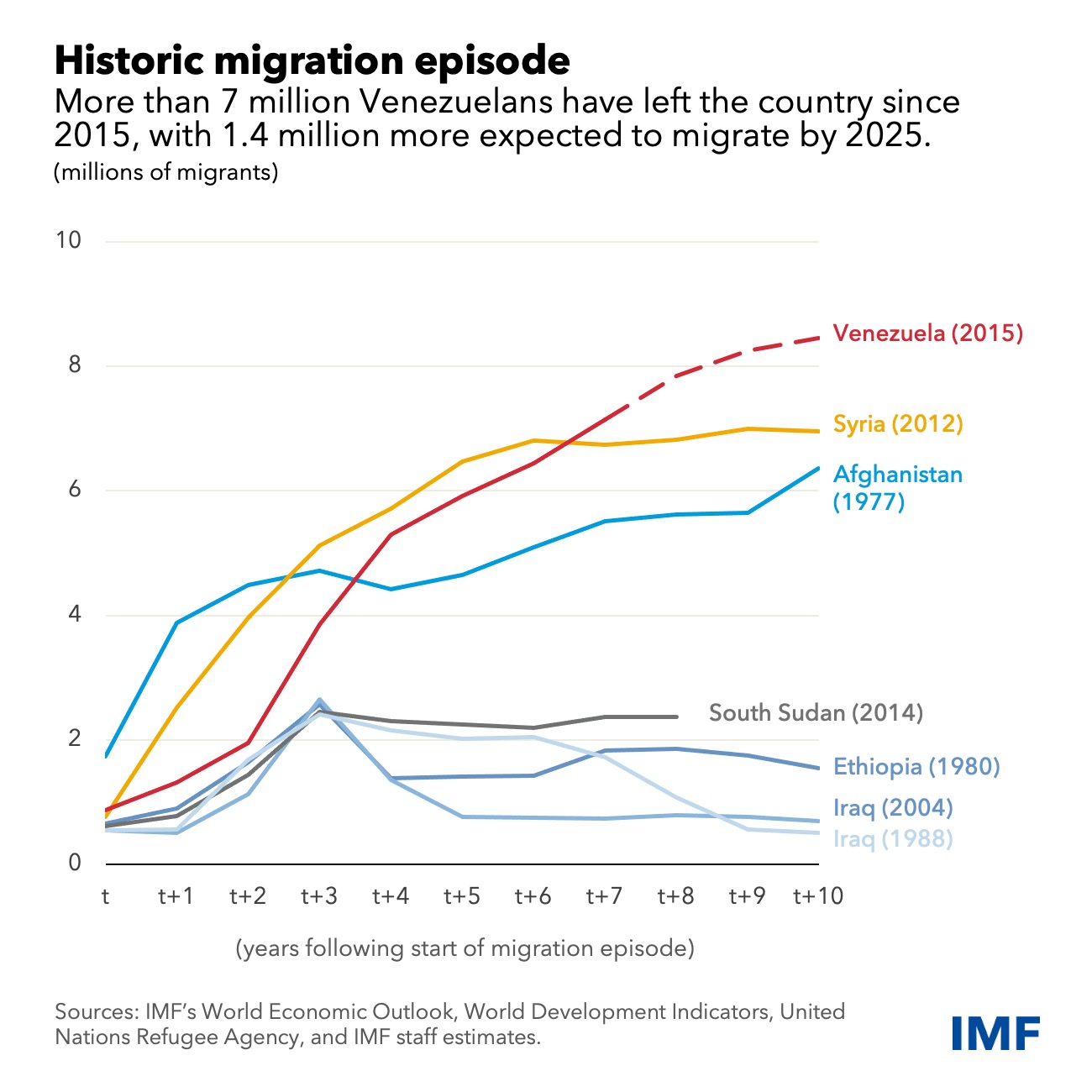
More than 7 million Venezuelans have fled the country since 2015, with 6 million settling in other Latin American countries.  The region’s largest migration episode in history is driven by the collapse of the country’s economy, which has left Venezuelans struggling to meet their basic needs.

Between 2013 and 2021, Venezuela’s gross domestic product is estimated to have declined by more than 75 percent, the most for a country not at war in the last 50 years.  The COVID-19 pandemic compounded the country’s economic and humanitarian crisis, and in 2020 more than 95 percent of Venezuelans were living below the poverty line.

The arrival of Venezuelans seeking better lives has strained the economies—and societies—of Latin American host countries that are already balancing tight budgets, especially since the pandemic.

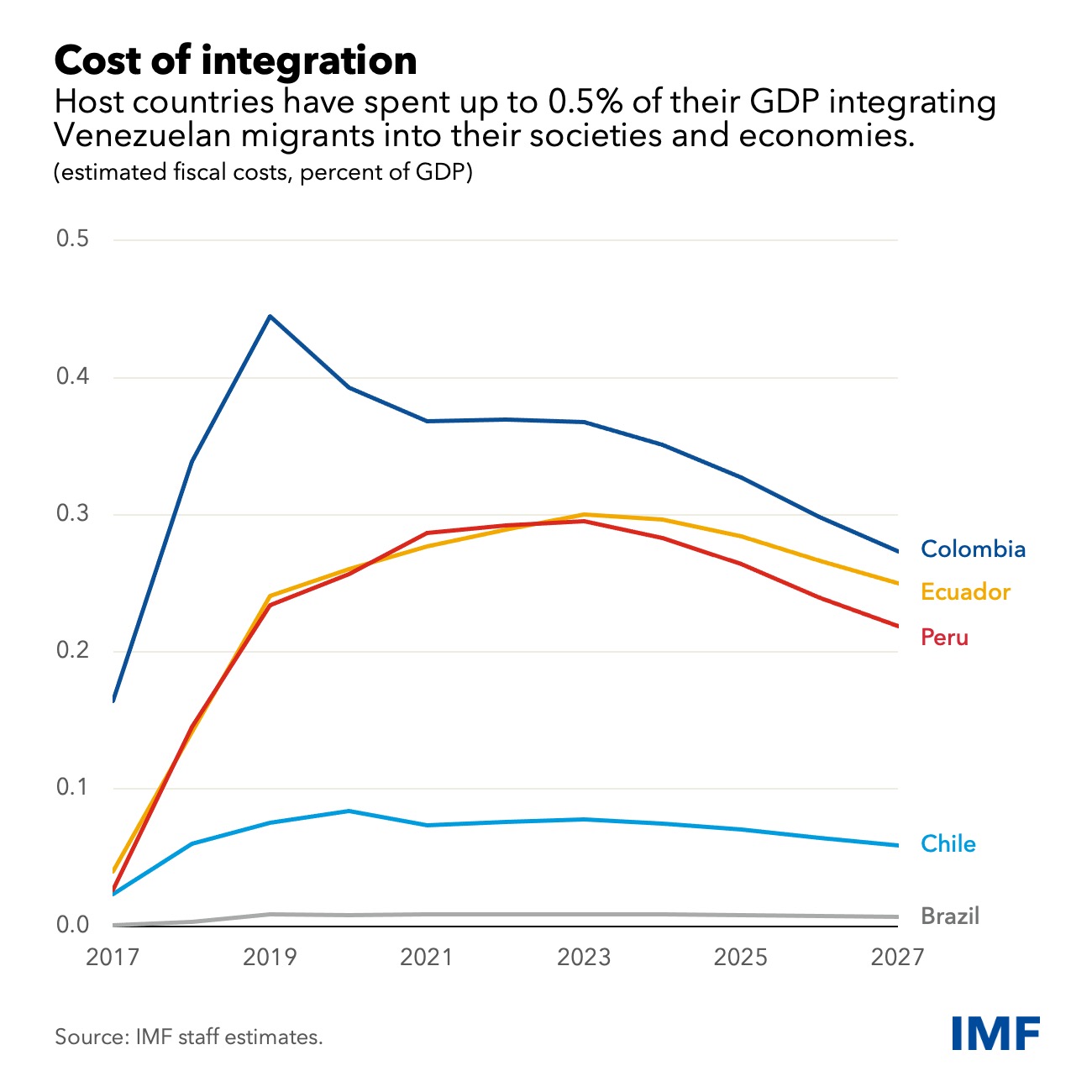
Colombia, which has received the most Venezuelan migrants, estimated spending about $600 per migrant in 2019.  This covered humanitarian aid, healthcare, childcare, education, housing, and job-search support.  With more than 2 million arrivals, this translates into $1.3 billion in assistance.  In 2019, this cost peaked at 0.5 percent of Colombia’s GDP.

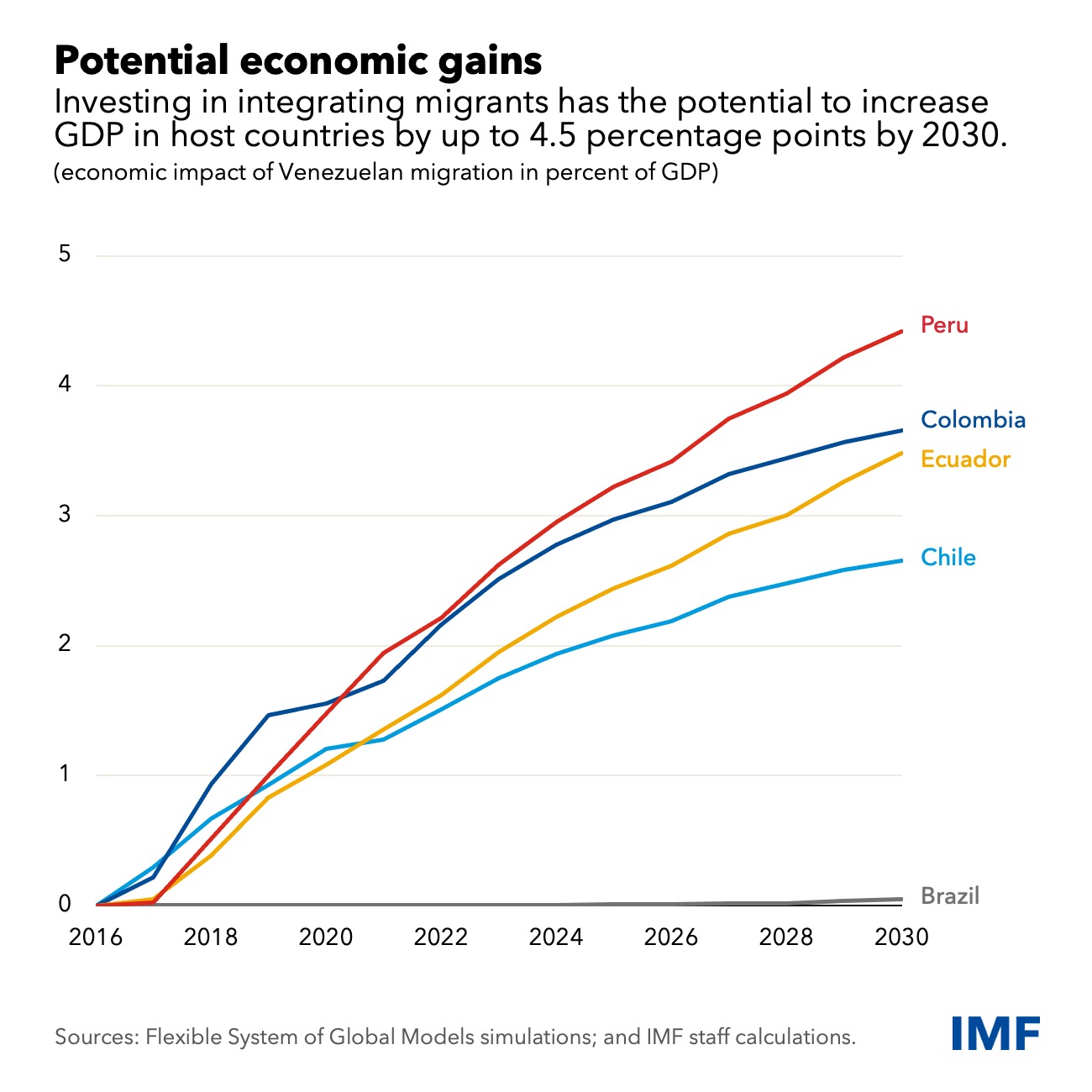
In the long term, however, this investment has the potential to increase GDP in host countries by up to 4.5 percentage points by 2030, as we find in our latest research on the spillovers from Venezuela’s migration.

To reap the benefits from migration, host countries need to integrate the new arrivals into the formal labor force—and society—by promptly offering them work permits and access to education and healthcare.

Migration flows

After a brief interruption during the pandemic, when many countries closed their borders, migration from Venezuela has resumed and is expected to continue in the coming years, although at a slower pace.

We estimate that Venezuelan migrants will number around 8.4 million by 2025—more than 25 percent of the country’s population in 2015.


The characteristics of migrants have evolved as the economic crisis intensified.  The first wave of migrants were mostly professionals with high levels of education.  The second consisted of middle-class young people with a university degree.  Since the economy collapsed in 2017-2018, migrants have tended to be from low-income households and with lower levels of education.

Overall, the demographic profile of Venezuela’s migrants is like that of the local population in host countries.  Almost two-thirds are of working age and almost half are female.

Most have settled in other Latin American countries, while some have migrated to North America and Europe, mainly the US and Spain.

While Colombia remains the main destination, Chile, Ecuador, and Peru have also received sizable flows, with their combined number of migrants exceeding 2 million, more than 3 percent of the local population on average.

Effect on labor markets

Our research finds that Venezuelan migrants—many of them more educated than the local populations—face higher unemployment, are more likely to initially work in the informal sector, and earn less than the local workers. 

We didn’t find evidence that migrants are displacing domestic workers, although we have seen downward pressure on wages in the informal sector.

The wage gap between domestic and migrant workers grows with the level of education, which suggests a misallocation of human capital—workers’ skills, knowledge, and expertise—as educated migrants tend to only find unskilled jobs.  On average, domestic workers earn about 30 percent more than migrants.

Cost and benefits

Our analysis finds that providing migrants with humanitarian assistance and access to public services carries a sizable fiscal cost and puts pressure on the budgets of host countries, as the Colombia example shows.


But the analysis also identifies large medium-term gains in productivity and growth resulting from an increase in the labor force and better alignment of migrants’ human capital with jobs.  These gains are greater for countries that receive larger and more educated migrant flows relative to the domestic population.

We estimate that, with the right support and integration policies, migration from Venezuela has the potential to increase real GDP in Peru, Colombia, Ecuador, and Chile by 2.5 to 4.5 percentage points relative to a no-migration baseline by 2030.


We also project that the cost of integrating migrants would narrow over time as migrants join the labor force, increasing economic activity and expanding the tax base.

Continued support

Early in the migration crisis, countries in Latin America welcomed Venezuelan migrants and provided support in the form of visa waivers, mobility cards, and access to humanitarian assistance, healthcare, education, and childcare.  Migrants also received work permits and credentials to help them integrate into the labor market.

However, in 2018 and 2019, we saw a shift in policies as migration flows intensified.  While some countries introduced new programs to facilitate the integration of migrants, others made it harder for Venezuelans to enter by requiring additional documentation.

Countries should continue supporting migrants and helping them integrate into the formal sector so they can find jobs that are in line with their human capital and increase productivity in the economy.

This will require improving transitional arrangements and asylum systems, bringing in migrants into the health and education systems, and formalizing migrant workers by giving them work permits and accelerating the accreditation of skills and education.

To cover the costs of implementing these policies, countries should seek help from donors and international institutions.  The IMF is analyzing the impact of migration and coordinating with the United Nations High Commissioner for Refugees and other relevant agencies to help countries access funding sources.

Countries in the region should also agree on a coordinated response to the migration crisis, in which each one contributes its fair share to the support and integration of migrants.

Source

Thursday, November 10, 2022

Threats to Venezuela's Food Sovereignty

Fuel, Cartels and GMOs: New Challenges in the Venezuelan Countryside

Expensive fuel and inputs, agribusiness cartels and GMO seeds are present threats to Venezuela's food sovereignty according to grassroots collectives.


Food Sovereignty Venezuela
From the onset of the Bolivarian Process, the Hugo Chávez government implemented policies to democratize food production in Venezuela.

From the 2001 Land Law all the way to the nationalization or creation of companies such as AgroPatria or Pedro Camejo (1), the goal was to ensure the sector was not subjected to the whims of the market and to support small and midsize production, especially from popular power organizations.

In recent years, an economic crisis heavily exacerbated by US sanctions has driven a liberalization of economic policies.  The Venezuelan countryside has been no exception.

One hurdle after another

The tools that once propped up campesino production have disappeared step by step.  The so-called “strategic alliances” have seen companies that supplied seeds and fertilizers (AgroPatria) or tractors (Pedro Camejo) transferred to the private sector.  This new scheme benefits large-scale producers above all.

In cases like sugar, state-owned mills have likewise been handed over to private owners, with devastating consequences for cane growers.

The latest blow has been the government decree that diesel be sold at 50 cents a liter, a price that might be unaffordable for many campesinos.   Amidst severe fuel shortages, diesel had been available either through a rationing plan or via the black market, but little by little the sale at “international” prices has become widespread.  Diesel is crucial for agriculture, fueling tractors to plow the land and trucks to transport harvests.

Fuel shortages have been tougher for us than the (Covid-19) pandemic,” Ricardo Miranda, from the Pueblo a Pueblo collective, told Tatuy Tv.

Pueblo a Pueblo brings together some 270 campesino families in the center-west part of the country.  Its main goal is to link directly with organized urban communities to distribute food at fair prices, without intermediaries.

Though diesel at 50c/L has been made “official” recently, Miranda said that in states such as Trujillo the alternatives are buying it at US $2 a liter from smugglers or enduring queues that could last for weeks.

“This price has a knock-on effect on all budgets and transportation costs.  This will mean a larger burden for the people and another source of inflation,” the Pueblo a Pueblo member claimed, adding that whatever subsidized fuel remains has been directed to large-scale producers.

Andrés Alayo, spokesman from the Campesino Struggle Platform, also stated that “production costs are sky-high” for campesinos presently.

“Between the dollarized fuel, the very expensive inputs and plowing, etc., producers are in a very delicate situation,” he summed up.

For his part, Miranda stressed that even under difficult conditions, campesino families continue producing and providing a large percentage of the food that is consumed.  In his opinion, the current circumstances have led to an expansion of agroecological practices and alliances between grassroots organizations.  Pueblo a Pueblo currently has a program with the Ministry of Education and urban collectives to supply some 250 school canteens across the country.

Still, hurdles for small and midsize production are just part of the picture.  The flipside is a playing field that is ever more tilted in favor of large landowners and agribusiness.

Cartels and dumping

“The fastest growing sector in Venezuela in recent years has been agroindustry,” Alayo told Tatuy Tv.  The growing influence of large conglomerates begins to be felt.

In recent weeks there have been several protests from corn producers who demand that the government regulate harvest prices.  Though some institutions, including the vice presidency, pledged to address the concerns, there has been no answer thus far.

According to the Campesino Struggle Platform spokesman, there are clear “cartel” dynamics at play. “For agroindustries it is very cheap to import corn, and they use that to set prices that are completely impossible to meet for national production.”  Alayo highlighted that it the state’s prerogative to “intervene” and protect its sovereignty.

The Platform, which played a key role in the 2018 Admirable Campesino March, does not rule out another massive mobilization in defense of campesino rights in the coming weeks.

Miranda expressed a similar opinion: “monopolies put pressure on the government,” which not only fails to support campesinos but leaves the market to be ruled by business sectors.  “It is a perspective that sees food as a commodity that is becoming more and more prevalent,” he concluded.

A further “threat” for rural producers has been the reopening of the Venezuela-Colombia border.  According to Alayo, campesino groups from the Andean region are sounding the alarm bells over a “massive dumping” of Colombian goods, especially vegetables.

“If our campesinos end up bankrupt, Colombian agribusinesses will take over the market and hike prices,” he warned.

For his part, Miranda explained that Colombian produce has informally crossed the border in recent years by just paying covert “taxes” to what was then the government-appointed “protectorate” in Táchira state (2).  Nevertheless, he believes the regularization of border crossings and the levying of import/export customs tariffs on both sides will eventually mitigate the impact of food coming from Venezuela’s neighbor.

Potatoes are a priority foodstuff for Pueblo a Pueblo.  “Colombia has free trade agreements that saw its market flooded by foreign potatoes (e.g. frozen french fries) which then had consequences on this side of the border,” he detailed, stating that Colombian potatoes were much cheaper than Venezuelan counterparts.

Gustavo Petro’s customs policies and the reactivation of Venezuelan production after the pandemic have allowed Pueblo a Pueblo to once again set up its “potatoes for life, not for capital” program.  Campesino organizations store potatoes for months at high altitude before releasing them on the market at fair prices to tackle speculation.

A (genetically) modified scenario


The rise of agribusiness in Venezuela has been quite visible, and it has even been showcased in government broadcasts.  There are large tracts of land that grow two products above all: corn and soy.  But this practice has another facet to be taken into account: the use of genetically modified seeds.

Campesinos have denounced the presence of GMO seeds in different parts of the country.  This violates the 2015 Seed Law,” Esquisa Omaña told Tatuy Tv.  She is a member of the “Venezuela Free from GMOs” campaign.

The organization has not had access to the alleged seeds but has called on Venezuela’s National Seed Commission (Conasem) to investigate the complaints.  However, according to Omaña, there is currently “no capacity or interest” from institutions to address the situation.

The activist, who is also a researcher at the CiECS center in Córdoba, Argentina, said that a common practice involves bringing in corn labeled for consumption which is then repackaged and sown.  While the use of genetically modified seeds is illegal, importing genetically modified food is not.

“The issue of food sovereignty is key, but even beyond that the consequences of GMOs have been well established,” Omaña affirmed.  “The seeds come with a technological package, with chemicals such as glyphosate that contaminate the air and soils. This is the deadly agribusiness model,” she concluded, referring to studies that show how toxic substances end up in soft tissue.

The “Venezuela Free from GMOs” campaign has argued that packaging legislation, alerting consumers to the presence of GMOs, is a priority.  Similar laws have been enacted in Europe and elsewhere.

At the same time, Omaña brought up the importance of “working on public consciousness” to generate healthier consumption habits.  By shifting more towards legumes (e.g. beans), tubers (e.g. sweet potato) and musaceae (e.g. plantains) that are not associated with agribusiness, people will in turn be less vulnerable to its interests.

The crisis and the US blockade have had devastating consequences for the Venezuelan people, from deteriorated living conditions to mass migration.

In a context where sanctions are firmly in place and there are positive signs of economic recovery, it is just as clear that there is a reconfiguration process going on that surrenders protagonism to the private sector and multinational corporations.

In what concerns food production, agribusinesses have become the main actors, with the government openly calling for foreign investment in the sector and offering all possible advantages.  It is a “pragmatic” vision that imposes capitalist logic, or allows it to impose itself.

On the other side stand campesino families, some of them organized and others not, facing growing difficulties to go on producing.  The lack of state support is worsened by the cartel practices of corporations and the penetration of GMOs.  The threats to Venezuela’s food security and food sovereignty keep growing.

But at the same time, campesino movements have shown time and again that they are ready to struggle and fight, be it to accelerate radical changes or to resist attacks against the achievements of the Bolivarian Revolution.

Notes

  1. In 2010, Chávez nationalized seed and fertilizer supplier AgroIsleña over repeated complaints that it abused its monopolistic market position.  It was renamed AgroPatria.  In recent years, the company was plagued by corruption accusations and was transferred to private corporation AgroLlano 2910 in 2020.  Pedro Camejo was created in 2007 to supply tractors, transportation and technical support to rural producers.  Beginning in 2019, its plants and assets were transferred to regional governments which in turn passed them on to the private sector under “strategic alliances.”

  2. Blaming a lack of cooperation and hostility from opposition governors, the Maduro government appointed so-called “protectors” to four states where Chavismo lost gubernatorial races in 2017.

Source

Saturday, January 10, 2015

Rapprochement Between the United States and Cuba and Sanctions Against Venezuela

By WILLIAM CAMACARO and FREDERICK B. MILLS:

The Americas

In a historic address on December 17, 2014 on “Cuba policy changes” President Barack Obama declared, “our shift in policy towards Cuba comes at a moment of renewed leadership in the Americas.” This “renewed leadership,” in our view, seeks to gradually undermine socialism in Cuba, check waning U.S. influence in the region, and inhibit a growing continental Bolivarian movement towards Latin American liberation, integration, and sovereignty. To be sure, normalization of relations with Cuba and the release of Gerardo Hernández, Ramón Labañino and Antonio Guerrero were long overdue, and the reunification of Alan Gross with his family was an important and welcome gesture. The rapprochement between the United States and Cuba and the simultaneous imposition of a new round of sanctions by the U.S. against Venezuela, however, do not signal a change in overall U.S. strategy but only a change in tactics. As President of Venezuela Nicolas Maduro remarked in a letter to President Raul Castro “there is still a long road to travel in order to arrive at the point that Washington recognizes we are no longer its back yard…” (December 20, 2014).

From Embargo to Deployment of U.S. Soft Power in Cuba

The Obama gambit arguably seeks to move Cuba as far as possible towards market oriented economic reforms, help build the political community of dissidents on the island, and improve U.S. standing in the region, and indeed in the world. In a Miami Herald op-ed piece (December 22, 2014), John Kerry (Secretary of State), Penny Pritzker (Secretary of Commerce) and Jacob J. Lew (Treasury Secretary) wrote that normalization of relations between the U.S. and Cuba will “increase the ability of Americans to provide business training and other support for Cuba’s nascent private sector” and that this will “put American businesses on a more equal footing.” Presumably the op-ed is referring to “equal footing” with other nations that have been doing business for years with Cuba despite the embargo. The essay also indicates that the U.S. will continue its “strong support for improved human-rights conditions and democratic reforms in Cuba” by “empowering civil society and supporting the freedom of individuals to exercise their freedoms of speech and assembly.” Such a version of “empowering civil society” is probably consistent with decades of U.S. clandestine attempts to subvert the Cuban government, documented by Jon Elliston in Psy War on Cuba: The declassified history of U.S. anti-Castro propaganda (Ocean Press: 1999). It is also in line with more recent efforts, through USAID funded social media (phony Cuban Twitter) and a four year project to promote “Cuban rap music” both of which ended in 2012, designed to build dissident movements inside Cuba. In December 2014, Matt Herrick, spokesman for USAID, defended the latter unsuccessful covert program saying, “It seemed like a good idea to support civil society” and that “it’s not something we are embarrassed about in any way.” Moreover, a fact sheet on normalization published by the U.S. Department of State mentions that funding for “democracy programming” will continue and that “our efforts are aimed at promoting the independence of the Cuban people so they do not need to rely on the Cuban state” (December 17, 2014). The Cuban government, though, has a different take on the meaning of “independence of the Cuban people.” They emphasize “sovereign equality,” “national independence,” and “self determination.” In an address on normalization, Raul Castro insisted on maintaining Cuban sovereignty and stated “we have embarked on the task of updating our economic model in order to build a prosperous and sustainable Socialism” (December 17, 2014). Obviously the ideological differences between Washington and Havana will shape the course of economic and political engagement between these two nations in the months and years ahead.

Rapprochement Between the U.S. and U.S. Isolation in Latin America

Through normalization of relations with Cuba, the U.S. also seeks to end its increasing isolation in the region. Secretary of State John Kerry, in his Announcement of Cuba Policy Changes, remarked that “not only has this policy [embargo] failed to advance America’s goals, it has actually isolated the United States instead of isolating Cuba” (December 17, 2014). In October 2014, the United Nations General Assembly voted against the U.S. Cuba embargo for the 23rd year in a row, with only the U.S. and Israel voting in favor. The inclusion of Cuba in the political and, to a certain degree, economic life of Latin America, has also been part of a larger expression of Latin American solidarity that clearly repudiates regional subordination to Washington. Since the sixth Summit of the Americas in Cartagena (April 2012), the U.S. has been on very clear notice by the Community of Latin American and Caribbean States (CELAC) that there will be no seventh Summit of the Americas in Panama in April without Cuba, a condition to which Washington has ceded.

The flip side of Washington’s growing “isolation” has been the critically important regional diversification of diplomatic and commercial relations between Latin America and the BRICS nations (Brazil, Russia, India, China, and South Africa) and the construction of alternative development banks and currency reserves to gradually replace the historically onerous terms of the World Bank and the International Monetary Fund. The financial powerhouse of the BRICS nations is China. Over the past year, China has sent high level delegations to visit CELAC nations and in some cases these meetings have resulted in significant commercial agreements. As a follow up, there will be a CELAC–China forum in Beijing in January 2015 whose main objective, reports Prensa Latina, “is exchange and dialogue in politics, trade, economy and culture.” These ties with BRICS and other nations are consistent with the Chavista goal that the Patria Grande ought to contribute to building a multi-polar world and resist subordination to any power block on the planet. By bringing a halt to its growing isolation, Washington would be in a better position to increase its participation in regional commerce. The terms of economic engagement with most of Latin America, however, will no longer be determined by a Washington consensus, but by a North—South consensus. The Obama gambit, though, appears to be trading one source of alienation (embargo against Cuba) for another (sanctions against Venezuela).

Obama’s Gambit: Pushing Back the Bolivarian Cause at its Front Line–Venezuela

The Obama administration’s move to normalize relations with Cuba, while a welcome change of course, can be seen as a modification in tactics to advance the neoliberal agenda as far as possible in Havana while ending a policy that only serves to further erode U.S. influence in the region. Such diplomacy is in line with what appears to be a major U.S. policy objective of ultimately rolling back the ‘pink tide’, that is, the establishment, by democratic procedures, of left and center left regimes in two thirds of Latin American nations. It is this tide that has achieved some measure of progress in liberating much of Latin America from the structural inequality, social antagonism, and subordination to transnational corporate interests intrinsic to neoliberal politics and economics. And it is the continental Bolivarian emphasis on independence, integration, and sovereignty that has fortified the social movements behind this tide.

The Obama gambit, from a hemispheric point of view, constitutes a tactical shift away from the failed U.S. attempt to isolate and bring the Cuban revolution to its knees through coercion, to an intensification of its fifteen year effort to isolate and promote regime change in Venezuela. The reason for this tactical shift is that Venezuela, as the front line in the struggle for the Bolivarian cause of an increasingly integrated and sovereign Latin America, has become the biggest obstacle to the restoration of U.S. hegemony and the rehabilitation of the neoliberal regime in the Americas.

If this interpretation of U.S. hemispheric policy is near the mark, Obama’s grand executive gesture towards Cuba is immediately related to the context of Washington’s unrelenting antagonism towards Chavismo and, in particular, to the latest imposition of sanctions against Caracas. The reason for this is quite transparent. It has been Venezuela, more than Cuba, during the past fifteen years, that has played the leading role in the change of the balance of forces in the region on the side of sovereignty for the peoples of the Americas, especially through its leadership role in ALBA, CELAC, UNASUR and MERCOSUR, associations that do not include the U.S. and Canada. Argentine sociologist Atilio Boron, in an interview with Katu Arkonada of Rebelión (June 24, 2014), points out, “It is no accident…that Venezuela in particular is in the cross hairs of the empire, and for this reason we must be clear that the battle of Venezuela is our Stalingrad. If Venezuela succumbs before the brutal counter offensive of the United States…the rest of the processes of change underway on the continent, whether very radical or very moderate, will end with the same fate.” The latest U.S. sanctions against Venezuela can be viewed as one component of this counter offensive. It is to a closer look at the sanctions bill, signed into law by the president on December 18, 2014, that we now turn.

The “Venezuela Defense of Human Rights and Civil Society Act of 2014” (S 2142) not only targets Venezuelan officials whom U.S. authorities accuse of being linked to human rights abuses by freezing their assets and revoking their travel visas (Sec. 5 (b) (1) (A) (B)), it also promises to step up U.S. political intervention in Venezuela by continuing “to support the development of democratic political processes and independent civil society in Venezuela” (section 4 (4)) and by reviewing the effectiveness of “broadcasting, information distribution, and circumvention technology distribution in Venezuela” (section 6). One of the instruments of this support for “democratic political processes” has been the National Endowment for Democracy (NED). Sociologist Kim Scipes argues that, “the NED and its institutes are not active in Venezuela to help promote democracy, as they claim, but in fact, to act against popular democracy in an effort to restore the rule of the elite, top-down democracy” (February 28 – March 2, 2014). Independent journalist Garry Leech, in his article entitled “Agents of Destabilization: Washington Seeks Regime Change in Venezuela,” (March 4, 2014) examines Wikileaks cables that indicate similar efforts have been carried out in Venezuela by USAID’s Office of Transition Initiatives (OTI) during the past decade. Hannah Dreier (July 18, 2014), reported that “the State Department and the National Endowment for Democracy, a government-funded nonprofit organization, together budgeted about $7.6 million to support Venezuelan groups last year alone, according to public documents reviewed by AP.” The sanctions bill (S 2142), then, in light of these precedents, contains provisions that suggest an imminent escalation in the use of soft power to support the political opposition to Chavismo in Venezuela, though such funding has been banned by Caracas.

The current U.S. sanctions against Caracas are consistent with fifteen years of U.S. antagonism against the Bolivarian revolution. The measures send a clear signal of increased support for a Venezuelan political opposition that has suffered division and discord in the aftermath of their failed “salida ya” (exit now) strategy of the first quarter of 2014. The sanctions also undermine any near term movement towards normalization of relations between the U.S. and Venezuela. It is no surprise that provisions of the law that targets Venezuelan officials accused of human rights violations have gotten some limited traction inside this South American nation, with the executive secretary of the Venezuelan opposition Democratic Unity Roundtable (MUD), Jesús Torrealba, openly supporting this measure. This is probably not going to get the MUD a lot of votes. According to a Hinterlaces poll taken in May, a majority of Venezuelans are opposed to U.S. sanctions. There has also been a swift repudiation of sanctions by the Maduro administration and the popular sectors. On December 15, 2014, in one of the largest and most enthusiastic gatherings of Chavistas in the streets of Caracas since the death of Hugo Chavez, marchers celebrated the fifteenth year anniversary of the passage by referendum of a new constitution (December 15, 1999) and vigorously protested against U.S. intervention in their country. Even dissident Chavistas appear to be toning down their rhetoric and circling the wagons in the face of Washington’s bid to assert “renewed leadership” in the region.

There is no doubt that the Maduro administration is under tremendous pressure, from left Chavistas as well as from the right wing opposition, to reform and improve public security and deal effectively with an economic crisis that is being exacerbated by falling petroleum prices. What the government of Venezuela calls an “economic war” against the country has domestic and well as international dimensions. Although there is no smoking gun at this time that exposes a conspiracy, some analysts interpret the recent fall in oil prices as part of a campaign to put severe economic pressure on Iran, Russia and Venezuela, countries whose fiscal soundness relies a great deal on petroleum revenues. For example, Venezuelan independent journalist, Jesus Silva R., in his essay entitled “The Government of Saudi Arabia is the Worst Commercial Enemy of Venezuela,” argues that the Saudis and Washington are complicit in the “economic strangulation, planned from the outside, against Venezuela” (December 22, 2014). Whatever the cause of falling petroleum prices and despite the domestic challenges facing Caracas, it will most probably be the Venezuelan electorate that decides, through upcoming legislative elections, whether to give Chavismo a vote of confidence, not outside intervention or a fresh round of guarimbas and terrorist attacks perpetrated by the ultra right. For the large majority of Venezuelans reject violence and favor constitutional means of resolving political contests.

U.S. Sanctions Against Venezuela Evoke Latin American Solidarity with Caracas

The good will generated by rapprochement between the U.S. and Cuba has already been tempered by the almost simultaneous new round of sanctions imposed by Washington against Venezuela. It is important to recall, perhaps with some irony, that it was precisely the late Venezuelan President Hugo Chavez’s establishment of fraternal ties with a formerly isolated Cuba that drew, in particular, the ire of Washington and the virulent antagonism of the right wing Venezuelan opposition. Now it is Latin American and to a significant extent, international solidarity with Venezuela that may prove to be a thorn in Washington’s side. On December 12, 2014, ALBA issued a strong statement against the Senate passage of the sanctions bill, expressing its “most energetic rejection of these interventionist actions [sanctions] against the people and government of the Bolivarian Government of Venezuela.” The statement also warned “that the legislation constitutes an incitement towards the destabilization of…Venezuela and opens the doors to anticonstitutional actions against the legal government and legitimately elected President Nicolas Maduro Moros.” The communiqué also expressed solidarity with Venezuela adding that the countries of ALBA “desire to emphasize that they will not permit the use of old practices already applied to countries in the region, directed at bringing about political regime change, as has occurred in other regions of the world.” MERCOSUR issued a statement on December 17, 2014 that “the application of unilateral sanctions…violate the principle of non-intervention in the internal affairs of States and does not contribute to the stability, social peace and democracy in Venezuela.” On December 22, the G77 plus China countries expressed solidarity and support for the government of Venezuela in the face of “violations of international law that in no way contributes to the spirit of political and economic dialogue between the two countries.” On December 23, the Movement of Non-Aligned Nations stated that it “categorically rejects the decision of the United States Government to impose unilateral coercive measures against the Republic of Venezuela…with the purpose of weakening its sovereignty, political independence and its right to the self determination, in clear violation of International Law.” It is also important to recall that n October 16, 2014 the UN General Assembly elected Venezuela (by a vote of 181 out of 193 members) to a non-permanent seat on the UN Security Council with unanimous regional support, even crossing ideological lines. This UN vote came as a grave disappointment to opponents of the Bolivarian revolution and reinforced Venezuelan standing in CELAC. In yet another diplomatic victory, as of September 2015, Venezuela will assume the presidency of the Movement of Non-Aligned Nations for a three year term. Clearly, it is Washington, not Venezuela that has already become an outlier as the Obama administration launches its “renewed leadership in the Americas.” If these immediate expressions of solidarity with the first post-Chavez Bolivarian government in Venezuela are an indicator of a persistent and growing trend, then by the time of the upcoming seventh Summit of the Americas, April 10 – 11, 2015 in Panama, President Obama can expect approbation for Washington’s opening to Havana, but he will also face a united front against U.S. intervention in Venezuela and anywhere else in the region.

Note: Translations by the authors from Spanish to English of government documents are unofficial. Where citations are not present in the text, hyperlinks provide the source.

William Camacaro MFA. is a Senior Analyst at the Council on Hemispheric Affairs and a member of the Bolivarian Circle of New York “Alberto Lovera.”

Frederick B. Mills, Ph.D. is Professor of Philosophy at Bowie State University and Senior Research Fellow at the Council on Hemispheric Affairs.
 
Source: CounterPunch
 
January 06, 2015
 

Monday, October 27, 2014

The limits of changes – Venezuela: terminal crisis of the rentier petro-state?

by Edgardo Lander:


Venezuela’s failure to develop an effective strategy to reduce its economy’s dependence on gas and oil threatens the social successes and future viability of the Bolivarian project.


Over the 15 years of the Bolivarian government in Venezuela, significant changes have taken place in the political culture, the social and organisational fabric, and the material living conditions of previously excluded low-income groups. Through multiple social policies (known as “missions”) aimed at different sectors of the population, levels of poverty and extreme poverty have been reduced significantly.

According to ECLAC, Venezuela has become – together with Uruguay – one of the two countries with the lowest levels of inequality in Latin America. People are better fed. Effective literacy programmes have been carried out. With Cuban support, the Barrio Adentro mission has brought primary medical care to rural and urban low-income groups throughout the country.

The state pensions system has been massively expanded to include millions of older people. The increase in university enrolment has been equally extraordinary. For the last few years, a housing programme for people with low incomes has been taken forward. Unemployment has been kept at a low level and informal-sector employment has been reduced from 51% in mid-1999 to 41% in mid-2014.

The amount spent on social investment between 1999 and 2013 is estimated to total some US$650 billion. According to the UNDP, Venezuela’s Human Development Index rose from 0.662 in the year 2000 to 0.748 in 2012, taking the country’s human development ranking from medium to high.

This has been a time of dynamic grassroots organising and participation, with the setting up of Water Committees and Community Councils, Health Committees, Urban Land Committees, Communal Councils, Communes... Most of this organisational dynamism was the result of government policies expressly aimed at promoting these processes.

Equally important has been the weight of Venezuela’s experience – particularly its constitutional reform process – in the progressive shift or turn to the left that has taken place in Latin America over these years. Its influence has also been important in the setting up of various regional integration mechanisms – UNASUR, CELAC, Petrocaribe, ALBA – that have strengthened the region’s autonomy and lessened its historical dependence on the United States.

Nevertheless, the social changes that have taken place were not the result of equally profound changes in the country’s economic structure. On the contrary, the last fifteen years have seen a consolidation of the rentier state model, with an increased dependency on revenue from oil exports. Oil’s share of total export value rose from 68.7% in 1998 to 96% in the last few years. The value of non-oil exports and private sector exports has fallen in absolute terms during this time. Industry’s contribution to GDP shrank from 17% in 2000 to 13% in 2013. [1]

October 24, 2014

International Viewpoint 

Thursday, October 16, 2014

Paralysed Venezuela vs Thriving Bolivia: Two Faces of Socialism

By Hernán Luis Torres Núñez – Aporrea.org:


Hernán Luis Torres Núñez, a frequent economics commentator on leftist Venezuelan community forum Aporrea, argues that Venezuela should learn from Bolivian president Evo Morales’ pragmatic style of governance for “21st century socialism”. 


A few days ago a friend asked me if I’d written about the situation in the country again. I answered no, because the government hadn’t taken any action on the economy that served as an excuse for me to write something. The only thing that’s happened worth mentioning is the assassination of Robert Serra, which is in an area of events that isn’t my strength. Also I don’t like speculating about this type of issue, above all because the investigations haven’t finished solving the crime.

However it should be pointed out that not making decisions is a way of deciding. That is, maintaining the status quo is a way of signalling that although the situation is very difficult, making decisions can worsen the situation. This reminds me of the second government of [Rafael] Caldera [1994 - 1999]. When he was elected he put the economy in the freezer and let time pass. Caldera was clear that the economic adjustment measures of [former president] Carlos Andres Perez [1989 - 1993] had cost him his job. [Caldera] finally implemented these measures two years into his term, when the political atmosphere had calmed down.

These are very difficult times for the Venezuelan economy. We can’t exaggerate when we see indices of inflation and shortages of all kinds of products (because we no longer see the shortages indicator); when we see that dollars [for imports] are sporadically shared out to different economic sectors at a drip drop; when we see that oil is dropping to 80 dollars a barrel; when we have three official exchange rates to the dollar, each one overvaluing the bolivar and generating deep distortions in the economy; when we see that property prices reach 50 million bolivars (US $7.9 million at highest official rate); when the prices of used cars are crazy, etc. Therefore we can speculate that no economic decisions are being taken to stabilise the situation because these would have a very strong impact on Venezuelans’ quality of life. A strong devaluation toward one exchange rate, a generalised increase in prices (which has been happening surreptitiously), a petrol price increase, and a possible tax rise would make poverty rates violently shoot up. This situation would put the government against the wall, as its banner all these years has been the eradication of poverty. The goal of zero poverty would be smashed to smithereens.

On the other hand, it’s important to point out that politicians pursue power, and once obtained, they try to keep it for the longest time possible. Good economic performance is something that can favour the politicians in government, and bad management sooner or later ends up taking its toll and hastening the fall of the governors, above all if we live in an effective democracy. By virtue of what’s happening in the economy and with parliamentary elections next year, the fear of losing political power is a close possibility. As such, in these moments political calculation can impose itself over economic reality.

Meanwhile, Evo Morales has just won his third term in Bolivia, and overwhelmingly. Bolivia is experiencing economic growth, and in 2015 is expected to be the country that grows most in the region. There is a construction boom in La Paz, with new shopping malls full of foreign brands. In Bolivia there are no currency controls, and yet, international reserves reach 48% of GDP. It appears that there hasn’t been capital flight, and rather Bolivia is today a very attractive site for foreign investment. An important reduction in poverty has also occurred.

The opposition to Morales’ government, that at one point backed the division of the country, has softened its posture. Apparently Evo Morales has been capable of gaining the support of the middle class and some business. The conflict of his first years in government has given way to social, political and economic stability.

All of this drives us to think about what the key to success in Bolivia is, a country with far less resources than Venezuela but that has been capable of establishing a successful popular government, very different from the Venezuelan case. It’s necessary in the field of Venezuelan socialism that the Bolivian case is studied and the necessary lessons taken.

I’ve often heard the argument that other countries don’t have anti-patriotic parasitic bourgeoisies, a reasoning that seems contradictory and a little naïve, because in some way it’s saying that the success of socialism depends on the kindness and patriotism of the bourgeoisie, which is nonsense. The industrial bourgeoisie in all countries behaves in the same way, it invests to profit, and if it can’t profit it moves its capital somewhere else. We can’t forget that there was a moment that the Bolivian bourgeoisie and its half moon movement wanted to remove Morales from power the underhand way. If today the Bolivian bourgeoisie is investing and not encouraging capital flight it’s because it trusts that its investment will be respected and will perform well. All of this has occurred due to negotiation between the Bolivian bourgeoisie and Evo’s government.

The above is notable because Evo Morales has declared himself a Marxist and admirer of Fidel [Castro], however, it would appear that he is also a pragmatic man who understands that socialism of the 21st century has to be radically different than that of the 20th, something that the person who was our economic flag bearer, [former minister Jorge] Giordani, could never understand and less so put into practice. Strong applause for Evo Morales.

October 14, 2014

Translated by Venezuelanalysis.com.
 
Source: Aporrea.org