Google Ads

Showing posts with label women. Show all posts

Saturday, April 20, 2024

Cuba's economic model - significantly free from IMF's restrictions, exhibits a model where freedom propels progression

The Cuban Revolution Prioritizes Education


Cuba: A Beacon of Optimism from the Caribbean Region


By Dr Kevin Turnquest-Alcena
Nassau, The Bahamas


Living in English-speaking Caribbean, they typically experience democracy, often, by a fall back method creating a widespread matter called political clientelism.

Cuba
Governments of this system including, borrowing from Peter to fulfill Paul with no clear sustainable plan for settlement. As a result, people often bear high taxes for these loans. If the debt cycle isn't checked, there could be a very real threat of these countries finding themselves in a financial crisis! Resembling Argentina's saga described by high taxation and skyrocketed inflation leading to severe economic lack.

On top of it, countries, like Trinidad, face exchange control problems, where strict currency policies further entangle economic stability and growth, making it another layer of difficulty in handling national finances.

Cuba, on the other hand is free from these problems. By developing its own exclusive political and economic systems - it operates out of the borrowing and dependency loop, thus skipping high taxation and possibly financial crises troubling other Caribbean countries due to political clientelism.

In an age where genuine democracy often seems more of a dream than a reality, and global economies are firmly controlled by bodies, like the IMF. Anyway, Cuba positions itself as a beacon of flexibility and ingenuity. The island nation skillfully navigated the difficulties of a prolonged economic ban and international isolation, offering a model of self-reliance and innovation stirring its Caribbean surroundings and far beyond.

Economic Independence and Women Empowerment

Cuba's economic model, significantly free from IMF's restrictions, exhibits a model where freedom propels progression. This liberation is highly noticeable in the spread of stellar, micro-businesses, led often by women.

These ventures are more than simple economic activities, they're acts of empowerment - showcasing the crucial role women execute in Cuban society.

Nobel Laureate Amartya Sen's thoughts on small business are very relevant here, "Small enterprises are a reservoir of creativity and innovation, and they are crucial in the development of economies aiming for high growth and more equity." In Cuba, these micro-businesses notable contribute to societal flexibility and economic diversification, allowing the country to alleviate some of the impacts of international sanctions.

Healthcare and Education Advances

Cuba's dedication to healthcare and teaching stands as a primary part of its national identification. The nation's medical innovations, such as leading the fight against yellow fever and creating COVID-19 vaccines, highlight its resilience and capability against any odds. These contributions have not only improved Cubans' life quality, but also extended assistance to countries in the Caribbean, Latin America, Africa, and Asia.

The island’s educational feats are just as impressive. The Cuban Revolution greatly influenced these, which prioritized education. The establishment of the esteemed University of Havana in 1728, followed by the continued emphasis on education throughout the island reflects a deeply rooted belief in the transformative power of knowledge, whatever that knowledge may be - corn-growing or salsa-dancing.

Cultural Resilience and Worldwide Solidarity

Despite a severe economic US embargo estimated to have caused $600 billion damage over 65 years, Cuba, developed a wildly diverse cultural landscape! More or less 3,000 institutions devoted to the arts, music, and culture underline the nation's persistence in preserving its cultural wealth and personality! Fidel Castro's belief that, "The risk of being ridiculous is taken by the true revolutionary with great love," reverberates throughout Cuba’s efforts to keep its revolutionary spirit alive despite facing noteworthy hardships.

Further, Cuba's globally humanitarian contributions - mainly in healthcare, mirror Nobel Prize victor Toni Morrison's endorsement, "I have seen the doctors from Cuba; they go places where nobody else will go." Such comments highlight Cuba’s international health diplomacy role and its commitment to giving its medical expertise with the world.

Endurance Despite Adversity

Much like the zealous pineapple thriving on the beach, Cuba's experience under the US embargo echoes historical narratives of endurance and faith, such as those of Job, Daniel, Joseph, and the Israelites under Egyptian slavery. Much like all these characters, Cuba stands determined despite severe trials.

The End

Cuba's unyielding spirit presents itself as an inspiration cornerstone. Not only for its countrymen, but for its Caribbean vicinity and other emerging countries. With global problems like climate change becoming more urgent, Cuba's methods to sustainable development and social empowerments offer valuable resilience and innovation lessons. The people's unyielding determination assures us that, "this too shall pass," strengthening the island’s potential for a brighter, more prosperous future. United and working collectively, we can utilize Cuba’s resilience to achieve our community's prosperity and wellness aims.

Source

Friday, December 10, 2021

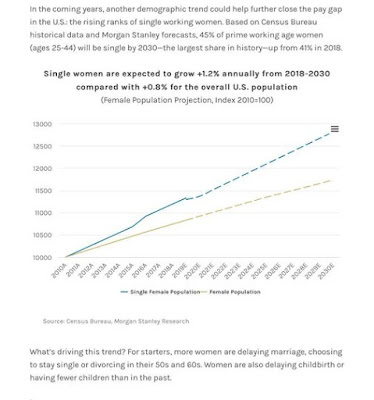
45 Percent of Prime Working Age Women (ages 18-44) will be Single by 2030 - the Largest Share in History

THE ERA OF FEMALE LONELINESS IS COMING!

By: Professor Gilbert Morris


The Rising Population of Single Working Women in the US
One must approach these subject matters with some intellectual discipline. What this data is…is not an attack on women. Second, it does not equate singleness with loneliness…because that’s silly.
This is a demographic and sociological problem at scale, which we see in dying villages in Japan (owing to ageing) and in China and India (owing to high concentrations of males).
Econometric analysis says a 17% demographic distribution in age or gender in a civilization, is a downward slope to toward extinction.

The difference in demographics in youth, because it posits potential, which neither age nor gender properness.
Therefore, this is not some happy notion of a gigantic global “girls night out”. This is a premonition of misery.
That is not because these data suggests conventional marriage. But rather, the social formations in which gender distributions ebbs beyond 17% comparatively, also points to shrinking capacity, creativity and resources.
This is why this study has been carried out by a bank. Because projecting an economic future, they can forecast the social entropy, dislocation and systems failures already emerging from this phenomenon.

Saturday, June 29, 2013

1 in 3 women abused worldwide

BY CORY COUILLARD


PHYSICAL or sexual violence affects more than one in three women worldwide, according to a new report released by the World Health Organisation (WHO) and partnering health authorities. The report represents the first systematic study of global data on the prevalence of violence against women.

"Some 35 per cent of all women will experience either intimate partner or non-partner violence," says the report. Additionally, 38 per cent of all women murdered were reportedly killed by their partners, and such violence is a major contributor to depression, alcohol abuse, sexually transmitted infections, pregnancy, and abortions.

"These findings send a powerful message that violence against women is a global health problem of epidemic proportions," said Margaret Chan, director-general of WHO. "We also see that the world's health systems can and must do more for women who experience violence."

Health impacts of violence

Violence in the home is a major contributor to women's mental health. The report found women who experienced partner violence to be nearly twice as likely to experience depression. Further, mental health disorders are skyrocketing as children view the abuse and it becomes a generational acceptance.

About half of mental disorders begin before the age of 14. Around 20 per cent of the world's children and adolescents are estimated to have mental disorders or problems. Stigma about mental disorders and discrimination often prevents people from seeking mental health care.

"Women experiencing intimate partner violence are almost twice as likely as other women to have alcohol-use problems," according to the WHO.

Alcohol use has short and long-term health consequences. It's a leading cause of depression and other mental health conditions as well as sexually transmitted infections. Women who experience physical and/or sexual partner violence are 1.5 times more likely to acquire syphilis, chlamydia, gonorrhoea or HIV.

Additionally, violence is a leading cause of unwanted pregnancy and abortion. The report found that women experiencing physical and/or sexual partner violence are twice as likely to have an abortion. If the female carries to term, they have a 16 per cent greater chance of having a low birth-weight baby -- a leading cause of infant mortality and complications.

"This new data shows that violence against women is extremely common. We urgently need to invest in prevention to address the underlying causes of this global women's health problem," said Professor Charlotte Watts, from the London School of Hygiene & Tropical Medicine.

"Gender-based violence is responsible for the psychological distress, which results in acceptance, which results in more violence, and consequently, more psychological distress: a cycle of risk and consequence," said Rachel Jewkes from the South African Medical Research Council.

Psychological distress and alcohol use also makes it much harder for women to protect themselves. It makes them more likely to accept the man's dominance in the relationship and she is more likely to have frequent sex without a condom, explains Jewkes.

Women often suffer isolation, inability to work, loss of wages and lack participation in activities. These common outcomes will prevent and limit a woman's ability to care for herself and her family.
Sadly, a common side effect of abuse is more abuse - It's a downward spiral.

Dr Cory Couillard is an international health care speaker and columnist for numerous publications throughout the world. He works in collaboration with the World Health Organisation's goals of disease prevention and global health-care education. drcorycouillard@gmail.com. twitter: DrCoryCouillard

June 26, 2013

Jamaica Observer

Saturday, March 10, 2012

As we celebrate International Women’s Day and look forward to the 50th anniversary of the Women’s Suffrage Movement in The Bahamas...We must examine the role that the Bahamian woman plays in the social and economic development of our nation - The Bahamas... ...We must encourage our Bahamian women who feel trapped ...to take the limits off of their minds and become innovative to find ways to progress economically


International Women's Day Bahamas


Economic empowerment for women through entrepreneurship


By Melisa Hall

Nassau, The Bahamas


As we celebrate International Women’s Day and look forward to our 50th anniversary of the Women’s Suffrage Movement in The Bahamas, we certainly salute, honor and recognize all of those Bahamian pioneers and trailblazers who have made significant strides and accomplishments that we the women of the 21st century are beneficiaries of.


As we continue to cherish the historic moments, successes, victories and challenges they overcame to empower women socially, economically, politically and nationally, it is only fitting that we also use this occasion to take an introspective look and evaluate where we are on the global scale of economic empowerment for women.

We must examine the role that the Bahamian woman plays in the social and economic development of our nation.   Here are a few questions we should consider:

• Are we consistent carriers of a progressive movement towards educating, enhancing and empowering our women to have a voice across the board in all equal facets of the economy?

• In what ways can we continue to contribute to the development of our younger generation to appreciate and value the significance of the Bahamian woman?

• What role is the government playing in developing and creating initiatives to empower and promote the advancement of women and is this an area that is often overlooked?

• Are there others mechanisms we can implement corporately or individually to open avenues for women to succeed?

Over the past few years and in recent times I have had the privilege and opportunity to meet so many women while hosing the annual business conferences for women, namely Kingdom Women in Business (KWIB).

What was and still is apparent to me is that most of these women sincerely aspire to be and do more for themselves professionally and economically, but oftentimes regardless of their marital status be it single or married, many of them feel trapped, restricted and prohibited; trapped in abusive relationships, restricted by their social peers and prohibited by their male counterparts especially in the workplace.   In most cases they simply feel financially bound.

We must therefore train and teach our youth and adult women, especially those who have found themselves in a pit, that through the power of God, belief in themselves along with timely information, tools and initiatives that there is a way to the palace.

As we can see from our heroines like Dame Doris Johnson, Mary Ingraham, Mabel Walker, Georgianna Symonette, Eugenia Lockhart, Althea Mortimer, Albertha Isaacs, Grace Wilson, Mildred Moxey, Ethel Kemp, Gladys Bailey and Madge Brown, Janet Bostwick, just to name a few, the road and journey was not easy but it is possible to make significant achievements as a woman.

We must continue to advocate for equal opportunities for women socially, economically, politically, constitutionally, corporately, nationally and most certainly legally.   We must encourage our Bahamian women who feel trapped to take the limits off of their minds and become innovative to find ways to progress economically.

Personally, I want to challenge every woman who may feel suppressed, oppressed and depressed to use this time of reflection to position yourself to succeed.

One of the ways you can do this is through entrepreneurship.   Entrepreneurship, while challenging, will build your confidence and will definitely teach you the art of becoming economically empowered.

Here are three preliminary steps you can take towards becoming an entrepreneur.

1. Discover your purpose: Take an inventory and assessment of your skills, gifts, talents, strengths and weaknesses.   Be true to yourself and identify what it is you were born and created to do.   This is usually something you are really good at or would even enjoy doing even if you did not get paid to do it.   There is indeed something unique inside of you.

2. Have a plan and a vision: Imagine where you would want to be in the future and create a step by step process to get there.   Remember there is a process.   Know where you are and seek help through a mentor, coach or professional who can help you to get where you want to be.   This also means that you must count the cost, don’t just quit your job but create a financial plan towards starting your business.

3. Be prepared and persistent: Go back to school if you have to, become educated and qualified if necessary and attend training sessions that will enhance you.   Begin to hunt and gather information about what you want to do.   Be real and find out if there is really a need for your product or service, and don’t quit.   If our forerunners have done it, you can too.

In closing, as we continue to stand on the shoulders of those who have paved the way forward, we must remain confident in the ability that God has placed on the inside of each of us to bring transformation to build our nation and become economically empowered as women through entrepreneurship.

  • Melisa Hall is an attorney, advocate for women’s empowerment and business coach who hosts monthly workshops for women.

You may contact her at 341-2204, or reach her via Facebook.

Mar 08, 2012

thenassauguardian