Google Ads

Sunday, September 22, 2013

Bolivia advancing in the battle against hunger

By Héctor Miranda, Correspondent/La Paz


THE 70 legislators from 20 countries in the region who took part in the 4th Parliamentary Front Forum against hunger in Latin America and the Caribbean returned home convinced that Bolivia is fighting valiantly to erase hunger, one of the ills suffered by its population.

The meeting, which met over two days in the eastern city of Santa Cruz de la Sierra, was an opportunity to learn of the President Evo Morales government plans to improve the people’s nutrition, part of a long-term project which does not exclude current action.

In the opening session, attended by Vice President Álvaro García Linera, the importance of giving decision making powers to campesino organizations and small agricultural producers spread across the country was emphasized.

García Linera highlighted the importance of working for food sovereignty, but noted that this requires political decisions, a transformation of the productive system and empowering of the original campesino social organizations in the control of productive processes.

He also spoke of the need to diversify food cultivation after the colonization of Latin America annihilated the scientific knowledge, engineering, biotechnology and astronomy inherited from civilizations with advanced agricultural and water cultures, among them that of the Inca people.

He likewise recalled that capitalism imposed a regime of food economy subject to the free market and profit in Latin America.

When President Evo Morales assumed power in early 2006, four million of Bolivia’s 11 million inhabitants suffered hunger; a figure that has been reduced by half to date, but which does not satisfy those responsible for leading the country and facilitating better living conditions for its people.

The two million persons still experiencing hunger in Bolivia are part of a 30 million total in Latin America, or 1.2 billion in the world, a problem which would seem more and more difficult to solve.
 
 
BOLIVIA, WATER AND THE BICENTENNARY AGENDA

The first steps to turn around the situation took place in 2006 itself and became established over time, with an awareness of the need to obtain food sovereignty, based on the democratization of land and the strengthening of the neglected campesino economy.

The government distributed tractors and other farming implements, together with seeds and fertilizer and directed strong capital investment to foment food production, apart from support received by the large agro-industrial companies.

On the other hand, through the MI Agua (More Investment for Water) programs, now in their third stage, water was delivered to the most remote areas of the country and all communities, not just for drinking, but to increase production and make it possible for cultivators to be assured of harvests without being dependent on capricious rainfall.

President Evo Morales has reiterated on more than one occasion that he knows of campesinos who previously cultivated one product once a year. Now, with the possibilities provided by water, they can produce various harvests.

In 2012, Bolivia also implemented agricultural insurance to protect the finances of small farmers affected by natural disasters, with a compensation of 1,000 bolivianos ($145) per hectare.

All of this is included in the so-called pillars of the 2025 Patriotic Agenda, a strategy directed toward solving vital problems in the country to coincide with the bicentenary of Bolivian independence, the objectives of which were the central issue addressed at the Forum, convened to discuss, exchange experiences and learn about Bolivia’s advances in food security. (Orbe)
 
September 19, 2013


Thursday, September 19, 2013

Bahamas: ...The old Progressive Liberal Party (PLP) lost its way long ago ...and the so-called ‘new PLP’ has failed to find it


PLP Bahamas


Sir Lynden’s and the PLP’s entitled imperial court


By frontporchguardian@gmail.com


During the 2012 general election, Sir Lynden Pindling’s widow took to the political stage as a part of the PLP’s strategy to use the late prime minister’s legacy to help the party secure victory.  It is debatable how successful was the strategy.

In her appearances, Dame Marguerite sought not only to burnish Sir Lynden’s legacy, which is considerable, and much of which is admirable and contributed extraordinarily to national development.

But many in the country at large, including many PLPs, were dismayed by her tone and remarks which harkened to a darker period in the nation’s history.

Once again on vivid display was that entrenched entitlement and imperious mentality of the Pindling Court: Don’t forget what we did for you and never forget that you owe us.


Former Prime Minister Hubert Ingraham was chastised as a mere recipient of the favors and consideration of the court, who had supposedly turned on his political masters and benefactors.

It was a not-so-subtle reminder to party Leader Perry Christie and all other supplicants expected to offer life-long obeisance to the court.

Seemingly, the PLP is a Pindling-owned and branded enterprise merely on loan to various caretakers who are to be held accountable to the dynasty.  All of which arises from an extraordinary combination of historical revisionism, mythology and hagiography.


Berated

At one of the rallies Dame Marguerite berated Ingraham for the way in which she felt he treated her husband after the latter left office.  Missing was any reference to the effusive thanks extended to Ingraham by Sir Lynden’s oldest son Obafemi Pindling at the funeral of his father, and which Ingraham graciously declined to use in response.

What has stunned, grated on, and even enraged so many of this lament is Lady Pindling’s seemingly absolute dismissal of the degrading and vicious treatment of many Bahamians by Sir Lynden and his court during his 25-year reign.

It was a ruthless and vindictive era.  Dissidents and opponents were to be destroyed.  And, quite a number were destroyed.

Lukewarm supporters and half-steppers were reminded of the price of disfavor: a quick call to a bank to stop a loan, blocked access to a job or to a scholarship for a child seeking to go to college, denial of a work permit for a spouse, and a catalogue of indignities and injustices.

There was gross and constant intimidation and victimization including the callous deportation of foreign spouses resulting in exile or the ruin of Bahamian families.

Those who opposed certain policies or wrong-doings or the court’s greed and corruption were set for abuse and ridicule, including veterans of the movement like the champion of Bahamian culture Edmund Moxey and the brilliant Carlton Francis.

Francis was cruelly ridiculed by Sir Lynden from a public platform.  He said of Francis who had participated in a public demonstration, “ ... And all I could see was suit!”, mocking a dying man thinned by the cancer ravaging his body.

Outstanding Bahamian educator and civil servant Leonard Archer fared even worse.  After he participated in a demonstration by teachers, Lady Pindling publicly asked: “What are we going to do about Leonard Archer?”  The next day he was fired by her husband “in the public interest”!

Tellingly, and of tremendous historical significance, more than half of those who formed the first majority rule government eventually left the PLP.  Yet there is the laughable conceit within the PLP of its superior nationalism.  It is a chauvinistic boast in a party given to all manner of chauvinism.

Even at the time when the Dissident Eight were leaving the party that they helped to build and contributed mightily to majority rule, Paul Adderley, then leader of the National Democratic Party (NDP), commented on their departure noting that the PLP was losing much of the soul of the party.

Decades later, following the death of Charles Maynard, a former PLP grandee remarked that the FNM is now the more progressive of the two major parties.  Maynard’s father, Andrew ‘Dud’ Maynard, an undoubted nationalist who toiled long and hard for the PLP, recently noted that the party he once knew and supported had lost its way.


Corrupted

Parties of liberation and majority rule cum independence often lose their way, corrupted by temptations of extraordinary political and economic power.  Examples abound across the globe.  The PLP is but one example of the chauvinism and sense of entitlement that sometimes develops in such parties.

The boundaries between party and state are blurred.  By example, what should be afforded an individual or a business as an opportunity arising from one’s rights as a citizen is twisted instead into a grant of favor by the party.

During the reign of Sir Lynden’s imperial court, many business people had to beg or bribe party officials for the grant of all manner of business licences and permits.

Independence leaders often become unaccountable and untouchable with their excesses dismissed.  Further, the assets of the state are spoils to be divided with plundering zeal by select interests.

Soon after coming to office Sir Lynden effectively destroyed Bahamas Airways – after his own government had negotiated with a consortium including the hugely successful Cathay Pacific to make the local airline truly international.  He summarily broke a prior agreement with Cathay Pacific by awarding certain routes to Bahamas World Airways, an airline conceived by his friend Everette Bannister and scoffingly referred to by many Bahamians as “the paper airline”.

In so doing he destroyed a golden opportunity for the country, resulting in the loss of an expanded local airline and causing a drain of approximately half a billion dollars from the treasury to keep Bahamasair operational.

Imagine what could have been done in terms of national development with half a billion dollars, not to mention a well-managed airline serving cities throughout the Americas.  So much for being the party of superior nationalism.

The PLP did considerable work in advancing the national good.  But many of the promises of majority rule were stillborn as the party abandoned a genuine nationalism for a pseudo nationalism that routinely touted and celebrated its liberation credentials even as it plunged the country into some of our darkest days.

That national nightmare involved a ‘nation for sale’ or lease to drug barons resulting in mass corruption, the destruction of scores of Bahamians who became addicted to crack cocaine or the easy money associated with the demon drug, and a ripping apart of our social fabric, from which we are still suffering up to this day.

Despite all of this, Sir Lynden and his court showed scant remorse.  It is chilling and deeply disturbing still to read the Commission of Inquiry Report into this nightmarish period and to peruse some of the evidence given.


Oligarchy

The PLP, the supposed party of superior nationalism, is today an oligarchy of special interests which uses the rhetoric and politics of nationalism to win elections with sloganeering such as “Bahamians First”, then governs mostly in its own interest.

This is the party in which one senior PLP bragged of selling off more land than the FNM, the party of the Great Mayaguana Land Giveaway, the party in which the two top senior leaders have a clear conflict of interest with an oil exploration company.

Having militantly opposed advancing the rights of women in terms of passing on certain rights of citizenship, the party holds a special session of parliament to brag about its commitment to women and to celebrate the 50th anniversary of women attaining the right to vote.

There is a pattern here.  The PLP, often quite effectively, employs the symbols and the narratives of nationalism to reinforce its credentials as the nationalist party.  The FNM has often played into its hands.

Given repeated opportunities to make January 10 a national holiday, the FNM was often on the defensive, unsure of how to embrace and burnish its own commitment to a more expansive vision of the national good.

Sir Lynden and his court did not try to destroy the Dissident Eight and others in spite of who they were.  The PLP tried to destroy them and to deny their nationalist credentials precisely because of who they were and what they represented.

It is a feature of the sociology of organizations, from churches to political parties, that dissidents have to be destroyed and branded as heretics and traitors when they call into question how the organization to which they were dedicated may have betrayed its ideals and the people they were committed to serving.


The old PLP lost its way long ago and the so-called ‘new PLP’ has failed to find it.  The party remains dedicated to a certain chauvinism, on stark display at the recent election as the widow of the party’s longest serving leader reminded Bahamians of what it feels that the country still owes the PLP’s entitled imperial court.

September 19, 2013

thenassauguardian

Sunday, September 15, 2013

Bankers are concerned about the proposed Value-Added Tax (VAT) ...and other government initiatives facing the sector in The Bahamas

Vat 'Uncertainty' Puts Bank Hires, Projects On Hold


By NEIL HARTNELL
Tribune Business Editor
Nassau, The Bahamas


VAT Bahamas
A top banker has warned that the uncertainty created by the proposed Value-Added Tax (VAT), and other government initiatives facing the sector, has caused institutions to place new hires and capital expansion projects on hold.
 
Ian Jennings, Commonwealth Bank’s president, said that with ‘financial services’ likely to be VAT ‘exempt’, the BISX-listed institution and other commercial banks would be unable to ‘net off’ the tax they paid on their inputs.
 
But, acknowledging that it was “not as simple” as a straight 15 per cent across-the-board increase for all Commonwealth Bank’s input costs, he said much would depend on whether VAT’s impact was mitigated by a corresponding reduction in Customs duty.
 
Still, Mr Jennings added that VAT, when combined with the new 3 per cent Business Licence fee and proposed Homeowners Protection Bill, had just added to “the level of uncertainty” facing the commercial banking sector.
 
“You’ve got uncertainty over the Homeowners Protection Bill, the impact of the increase of the Business Licence fees, and you’ve got the impact of VAT,” Mr Jennings told Tribune Business.
 
Pointing to the potential ‘Triple Whammy’ facing the sector, the Commonwealth Bank chief added: “There’s a lot of uncertainty, and as a result it makes you more cautious and much more reluctant as to whether you add staff and undertake future capital projects.”
 
Tribune Business has been informed that at least one commercial bank (not Commonwealth) has warned the Government that it may slash staff, and reduce its branch network via closures, if it brings VAT in as planned, while also maintaining the 3 per cent Business Licence fee.
 
This is because the combined impact of these new taxes would result in a significant bottom line contraction of anywhere between 10-40 per cent, especially given that commercial banks will, under the Government’s White Paper, be exempt from paying VAT.
 
This means that banks and other financial services providers, such as insurance companies, will join Doctors Hospital and healthcare providers in not having to register to pay VAT.
 
Nor will they have to charge the 15 per cent on customer bills. However, their ‘exempt’ status means they will not be able to claim back the VAT they will have to pay on their own input costs.
 
This has led to increasing concern throughout the financial services sector that VAT will spark an increase in their cost base, although the extent of this rise is uncertain.
 
“Our understanding at the moment is that the banks will be exempt, which means that while we will not be collecting VAT on our sales, we will be paying VAT on all our inputs. That means we could be looking at a 15 per cent increase in costs,” Mr Jennings told Tribune Business.
 
However, he acknowledged that it was not as easy as that. Mr Jennings said much would depend on what inputs, and suppliers, would attract VAT, and whether the promised reduction in Customs duties would “offset the increase with VAT”.
 
While VAT is unlikely to spark a 15 per cent increase in commercial bank input costs across the board, only goods will be impacted by a reduction in Customs duties, not services.
 
Mr Jennings noted that services purchased by Commonwealth Bank, such as accounting fees and legal fees, would attract the 15 per cent VAT with no possibility of a Customs duty offset.
 
“Some of those inputs will be increased,” he said. “In a lot of cases it depends on what that reduction in duty is to offset that 15 per cent VAT.
 
“At one time they were saying it was going to be revenue neutral. We have to wait and see for the detail.”
 
Mr Jennings said the banking industry’s single largest expense item was staff costs, something that should largely be unaffected by VAT. 
 
September 13, 2013


Wednesday, September 11, 2013

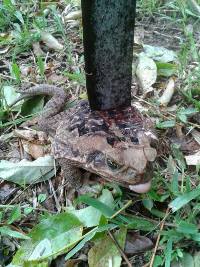
The Cane Toad is on the move in The Bahamas

The Cane Toad moves from Lyfordcay to Mount Pleasant Village


By Dennis Dames
Nassau, The Bahamas


The Cane Toad, Mount Pleasant Village
It’s on the move, and no one knows for certain the extent of the Cane Toad’s invasion on New Providence Island.  Recent news reports say that the exotic creature was confined to Lyfordcay. 

We know different now.  On Tuesday September 10, 2013 – a Cane Toad was found to be in the Mount Pleasant Village community.  The Lyfordcay police was notified, and action was taken to eliminate the venomous toad.  The Cane Toad undertakers quietly took the remains away.

The question now is:  Where will we find the next Cane Toad on our island?

According to Wikipedia, the cane toad has poison glands, and the tadpoles are highly toxic to most animals if ingested. Because of its voracious appetite, the cane toad has been introduced to many regions of the Pacific and the Caribbean islands as a method of agricultural pest control. The species derives its common name from its use against the cane beetle (Dermolepida albohirtum). The cane toad is now considered a pest and an invasive species in many of its introduced regions; of particular concern is its toxic skin, which kills many animals—native predators and otherwise—when ingested.

Saturday, September 7, 2013

The dirty rum war

Havana Club Cuba


By Gabriel Molina Franchossi:


Havana Club Cuba


FROM 1998 through 2003, the Bacardi company invested three million dollars in taking over the Havana Club trademark, in conspiracy with the Bush family.

This past June 25, Cuba and the European Union registered a complaint with the World Trade Organization (WTO), stating that they had been waiting for 11 years for the United States to revoke Section 211 of the Omnibus Appropriations Act of 1998, which legalized the theft of the trademark.

A book by Tom Gjelten, Bacardi and the Long Fight for Cuba: The Biography of a Cause, on the career history of the Bacardi family, exposes this incredible squandering of money. An audit demonstrated how, between lawyers’ fees, campaign contributions and expenses, the fight for Havana Club was highly expensive.

Rubén Rodríguez, president of Bacardi through 2005, wanted to get these expenses under strict control and disarmed the Cuba Group existing within the company, which coordinated Cuba-related issues.

The apologetic Bacardi book admits that, in response to the urging of his brother Jeb, George W. Bush violated international law and U.S. laws recognized by the U.S. Patent Office and the WTO, to utilize the Havana Club trademark in U.S. territory and sell supposedly Cuban rum. To a certain extent, Rodríguez distanced himself from the campaign waged by Pepin Bosch, the third president, who led the company into a hard-fought war against the Cuban Revolution, while triumphing as head of the family. "I made them all millionaires," he proudly declared in Miami.

Bosch contributed to the creation and funding of the Cuban Representation in Exile (RECE), which devoted itself to planning acts of terrorism against Cuba, and appointed Jorge Mas Canosa as group spokesman. The successful businessman wanted to put a non-family member at the head of the company, but Eddy Nielsen Schueg was opposed to this and Bosch resigned in anger in 1975. Nielsen took over the presidency and drew back from attacking Cuba. But some years later, alarmed by the challenge of the Havana Club Holdings (HCH) joint venture, created in 1992 between the French Pernod Ricard corporation and Havana Ron, once again started campaigning, at a time when HCH sales doubled in the fist four years of the venture’s operation.

In April 1995, company president Rodolfo Ruiz and Mas Canosa, president of the Cuban-American National Foundation (CANF), organized a banquet (at $500 per head) in the Coral Gables Biltmore Hotel, to finance the reelection of Senator Jessie Helms. This ‘give to get’ move was to place at Helms’ disposition the lawyer Ignacio Sánchez, so that he could draft Title III of the Helms-Burton Act with Daniel Fisk, the Senator’s man on the U.S. Senate Committee on Foreign Relations.

However, the Helms-Burton Act, baptized the Bacardi Claims Act by Wayne Smith, former director of the Cuba Bureau in the State Department, didn’t do the company much good; its extraterritorial pretensions clashed with European interests and forced a compromise with the EU, thus leaving many of its clauses without effect; year after year, U.S. presidents were forced to temporarily suspend the effects of Title III.

That fall, Bacardi loaded 16 crates of rum from its distillery in Nassau and marketed them in the United States with Havana Club labels. But in 1996, the French-Cuban HCH won a claim against Bacardi-Martini in a New York court, for violating a trademark registered by Cuba and approved by the U.S. Patent and Trademark Office in 1976.

Bacardi continued with its plan in 1997, buying the Havana Club franchise from the Arechabala family for $1.025 million. In real terms, this family had lost it in 1974, given that it did not renew its registration of the trademark or produce rum for 30 years. Nevertheless, Bacardi lawyers fixed their sights on abstracting their case from the 1928 Trademark Act, and had Congress approve a new bill, with retroactive effect, to deactivate the 1976 registration made by Havana Club to sell genuine Cuban rum. They used senators such as Connie Mack and Robert Graham, and Congress members IIeana Ros-Lehtinen and Lincoln Díaz-Balart, to add an amendment to the 1999 Omnibus Appropriations Act’s controversial Section 211 on the National Budget.

The illegitimate amendment allowed them to get around the U.S. Trademark Act when Judge Shira Scheindling, of the Southern District of New York, approved the Bacardi claim. But Havana Club Holdings succeeded in having the European Union and the WTO question the anomalous inclusion at the U.S. Patent and Trademark Office (PTO), which did not cancel the registration of the Havana Club trademark as Bacardi sought via the amendment. But under pressure from Bush, the PTO invalidated its own decision.

The spurious George W. Bush administration, which won the 2000 elections over Albert Gore through fraudulent voting in Florida, was grateful and rewarded the Miami mafia and Bacardi, among other benefits, the denial of Cuba’s right to continue paying for the registration of the Havana Club rum trademark in the United States.

In October 2002, The Washington Post published email messages supplied by the Florida Democratic Party, revealing how the then governor of Florida, Jeb Bush, made the U.S. Patent and Trademark Office change its position in favor of Bacardi.

When the PTO attempted to act in accordance with the law, Jorge Rodríguez Márquez, vice president of Bacardi, sent a brazen note to Jeb Bush, "Somebody has to tell the Patent Office to stop interfering," he demanded.

In response, Governor Jeb Bush replied on April 23, 2002, that his brother, the President, had appointed former Congressman James Rogan to supervise the PTO; and instructed Rodríguez to draft a letter to Rogan asking for "prompt and decisive action in favor of Bacardi," which he would sign. The letter, duly drafted by Rodríguez and signed by Bush, ordered an end to the dispossession immediately; as was carried out. The process revealed the high degree of complicity on the part of the Bush clan with corrupt individuals in Washington such as Congress members Tom De Lay and his colleagues Mel Martínez, Díaz-Balart and Ros-Lehtinen, funded by Bacardi.

The Post also reported on December 4, that Rodríguez Márquez had spent five million dollars since 1998, paying Congress members, and another $2.2 million hiring lobbyists.

Bacardi admitted to having used corporate funds to pay electoral campaign costs in Texas to the leader of the Republican majority, Tom De Lay. The company was fined a mere $750, despite demonstrating its involvement.
 
In 2002, the EU filed a lawsuit against this second Bacardi Act, and the WTO Arbitration Committee ruled that parts of Section 211 were in violation of the commercial commitments of the United States and needed to be amended by Congress in order to bring them into line with WTO regulations. Thus the United States was urged to adapt them within a reasonable amount of time, as they were in violation of accorded regulations in the Paris Convention for the Protection of Industrial Property.

The EU plaintiff agreed to give the U.S. more time to abide by this ruling, on various occasions. Thus, in 2004, Congress was presented with a bill on respect for trademarks, signed by legislators from both parties and supported by the National Foreign Trade Council, but the attempt was derailed by the very same legislators with identical bribes.

In July 2005, Europe and the Bush administration agreed, behind Cuba’s back, not to set a deadline for the United States to meet its WTO obligations; they agreed to abstain from asking the Solution of Differences body authorization to suspend concessions to the U.S. at this stage, until, at "some future date" they should decide to so. This understanding facilitated delaying the dispute for an indefinite period.

In this year’s hearing, European diplomats stated that it is time for the U.S. to resolve the issue and the Americans responded that a draft bill is in the hands of legislators in Washington to find a solution. They were informed that 11 years is more than enough time to adapt the regulation. But the 50-plus years of cold war against Cuba have broken the principles of the market economy which sustains this country’s ideology.

The dirty tricks of the Bush brothers and their protagonists in this rum war: Lincoln Díaz-Balart, Mel Martínez, Ileana Ros-Lehtinen, Tom De Lay and Jack Abramoff are among the more aggressive actors in the dirty war which Washington has insisted on maintaining. Given their corrupted and underhand nature, they constitute a 21st century Watergate. The pro-Batista Congress members of today are playing the same role as Nixon’s band of gangsters: Rolando Martínez, Virgilio González and Bernard Baker, together with Howard L. Hunt, James Mc Cord and Frank Sturgis.

To whom does President Obama have a debt of gratitude?
 
September 06, 2013
 

Tuesday, September 3, 2013

The Bahamas is yet to have a functioning Freedom of Information Act ...Maybe, it we don’t have one by the end of the year, Vienna can help

WHERE, oh where is that illusive Freedom of Information Act, 2012?


Freedom of Information Act Bahamas

Nassau, The Bahamas
 
 
The Act was passed by the FNM Government shortly before last year’s election, which swept the FNM from power. It was to come “into operation on such date as the Minister may appoint by notice published in the Gazette, and different dates may be so appointed for different provisions”.
 
Since then, it has gone AWOL - missing without leave. Hardly a month had passed after their election to parliament in May last year than “learned“ PLP politicians began pontificating on what areas of news reporters should be covering. They wanted reporters to focus on more positive news.
 
At that point, someone should have whispered in their ears that if they made positive news, reporters would happily write about it. Journalists neither make the news, nor do they cover it up. However, they do record what news is made by others. At the moment politicians are excelling in creating news, news that obviously they wish reporters would ignore. The news that they are now making is neither positive, nor is it intelligent. But it does reveal a strong tendency to cover up – a tendency to blow smoke screens to divert attention. Such a tendency is only bait to a well-trained reporter.
 
Last year, one of these politicians advocated more investigative reporting. He believed that it would produce more balanced reports, which would create a better informed public. How right he was. But where was the Freedom of Information Act that would make it easier for reporters to get such information?
 
It was nowhere to be found, but Deputy Prime Minister Philip “Brave” Davis had the brilliant idea to suggest that there should be punishment for “biased reporting”. And who was to be the arbiter of what was a biased report? Why the government, of course.
 
Since the publication of leaked documents revealing the shameful conditions at the Carmichael Road Detention Centre, FNM leader Dr Hubert Minnis says his party will now push for the passage of the Freedom of Information Act. We must remind him that his government, before it was removed from office, had already passed the Act. It is just awaiting a date to start acting. Unless, of course, this government now plans to amend it, which Attorney General Allyson Maynard Gibson indicated in March was the intention.
 
According to the Attorney General, although her government wanted to enact the law as soon as possible, it was now under review. There were certain sections, she said, that needed to be reviewed. “We don’t want to have a situation where we have actually brought something into force and it can’t work.”
 
Can’t work? Can’t work in favour of whom — the people or the government?
 
Already there are so many forbidden areas in the present Act that there will have to be skilful manoeuvring on the part of reporters to get certain information into the public domain.
 
Already, although they have protested that they want a better informed public, Foreign Affairs Minister Fred Mitchell is uncertain if he will release documents in connection with the Cuban beatings if, and when the inquiry has been completed.
 
The environmentalists are pushing for the passage of the Act to protect the marine environment. If environmentalists had prior warnings of developments that could adversely affect the environment and the livelihood of Bahamians, they could protest sooner. But, so far, permits are approved behind closed doors and before Bahamians know it a precious wetland has been destroyed or a public beach has disappeared.
 
In June last year, the publisher of The Tribune attended the International Press Institute conclave held in Port of Spain, Trinidad to receive a posthumous citation awarded her father, Sir Etienne Dupuch, as the world’s longest serving editor, who spent his life defending press freedom and fighting against social injustice in the Bahamas.
 
At that conference, among many other things that impeded press freedom, the Caribbean’s criminal defamation laws were highlighted, as well as those nations that did not yet have a Freedom of Information Act. It was decided that the IPI would launch a campaign for change in these areas,
 
We knew that the Bahamas would be targeted and so we were relieved that, just before we left for Trinidad, the Freedom of Information Act had passed the House. We reported that the Bahamas did indeed have a Freedom of Information Act.
 
We know that IPI, headquartered in Vienna, would be very interested to learn that the new government was still sitting on it. In fact, the Bahamas is yet to have a functioning Freedom of Information Act. Maybe, it we don’t have one by the end of the year, Vienna can help.
 
September 03, 2013
 

Sunday, September 1, 2013

Caribbean nations are to demand from their former metropolises economic and moral reparations for slavery, the genocide of their peoples, and the colonial practices to which they were subjected

The Caribbean has not forgotten


By Roberto Castellanos


IN their fight for the vindication of their peoples and the search for justice, the Caribbean nations are to demand from their former metropolises economic and moral reparations for slavery, the genocide of their peoples, and the colonial practices to which they were subjected.

The cornerstone of this demand was affirmed during the 34th Summit of the Caribbean Community (CARICOM), which took place in July in Trinidad & Tobago, and which gave the green light to the formation of a regional reparations group, to be supervised by prime ministers and presidents of the region.

The new institution will be responsible for coordinating the national commissions of each state.

The next step is a meeting in St. Vincent & the Grenadines in the first week of September, at which various leaders will have discussions with lawyers and historians to draw up a common strategy. The legacy of slavery includes endemic poverty and the lack of development which characterizes a large part of the region. Any agreement must contemplate a formal apology, but remorse by itself is not sufficient, stated President Ralph Gonsalves of St. Vincent & the Grenadines.

For this reason, CARICOM has retained the UK law firm Leigh Day & Co, which recently won a claim forcing London to compensate hundreds of Kenyans tortured during their liberation struggle, in the so-called Mau Mau rebellion (1952-1960), with more than $20 million. "Our first step will be to seek a negotiated agreement with the governments of France, Britain and the Netherlands in an attempt to resolve the issue amicably," stated lawyer Martyn Day.

However, David Fitton, British High Commissioner to Jamaica, made clear his government’s position by denying that this ruling set any precedent.

"We don't think the issue of reparations is the right way to address these issues," he said. "It's not the right way to address an historical problem."

Although there is no official data, it is estimated that 12 million Africans were taken by force from their continent and transported to the Western Hemisphere to work as slaves. Moreover, a significant number of them never reached their destination as they died in the crossing due to abysmal hygienic conditions, poor food and crowded into the ships’ holds.

While the Caribbean nations have not as yet presented a concrete monetary amount as compensation, regional media have referred to the compensation granted by the British to owners of Caribbean plantations after the emancipation of slaves in 1834.

Then, London paid colonialists approximately 20 million GBP, currently worth $200 billion.

According to Armand Zunder, president of the Suriname National Reparations Committee, during its occupation of this Caribbean nation, the Netherlands alone obtained a sum amounting to 125 billion euros at the current rate.

Nor is there consensus as to the destination of any sums contributed, but Gonsalves called for the creation of a compensation fund for the economic and social development of the region. (Orbe)
 
August 29, 2013


Saturday, August 31, 2013

Political ineptness in The Bahamas... ...


Bahamian Politics


Rights and wrongs of Cuban migrant dispute


By Front Porch
frontporchguardian@gmail.com
Nassau, The Bahamas


Last week was settling into another stretch of bad news for the inept and faltering Christie administration.  Suddenly, on Thursday, Opposition Leader Dr. Hubert Minnis handed a government in a defensive crouch a line of offense, an unexpected opening to attempt to switch the storyline from that of its gross incompetence to one of Dr. Minnis’ patriotism.

With the announcement of its trading places two-step, swapping the placements of ambassadors to the U.S. and the UN, the bungled appointment of Dr. Elliston Rahming neared a sort of climax, though leaving serious unanswered questions, the government on its heels, looking amateurish and incompetent.


Of alleged abuse of Cuban migrants at the detention center and the domestic and international fallout from what is now widely acknowledged as a fake video of the alleged abuse, the government seemed stuck in Goldilocks mode with Foreign Affairs Minister Fred Mitchell often too hot in his rhetoric and Prime Minister Perry Christie too cool when it came to taking charge of the matter.

The opposition was left with two prime opportunities to flex its policy and political muscles.  First, continuing to hammer away at the ambassadorial appointment fiasco.

Secondly, in the vacuum left by the government’s too cool indecision and too hot impetuousness on the Cuban migrant issue, Dr. Minnis had a golden opportunity to get it just right on a contentious matter at the intersection of domestic and foreign policy.

Tone-deaf

Prudence and good judgment are synonyms for getting it just right.  Gifted by events with the opportunity to demonstrate prudential judgment, Dr. Minnis proved to be foolhardy and tone-deaf.

Effective communication involves not just what one intends to says.  More importantly, it concerns what others hear you to say and what they don’t feel they have heard.

There are multiple issues related to the current Cuban migrant affair.  Dr. Minnis and the opposition are right in vigorously pressing for the full disclosure of any abuse at the detention center.

But what has been sorely lacking in the opposition’s response is a more comprehensive approach.  That approach should have included a clearer message reaffirming the opposition’s support of basic immigration policy relative of migrants.

More so, the opposition needed to be more emphatic in demonstrating national unity in the face of those seeking to scuttle our immigration policy, run roughshod over Bahamian sovereignty and inflict damage to our tourist-based economy.

Dr. Minnis’ failure to ensure the proper sequencing and calibration of the FNM’s messaging left the opposition open to severe criticism.  And it has been withering, from charges of recklessness to failing to stand up for the country.

While Dr. Minnis may not have shown the best judgment in handling the complex of issues at hand, attacks on his patriotism and that of the opposition are ridiculous and offensive.

Mitchell is no more of a patriot than Dr. Minnis.  And vile and contemptuous are claims by some that various of Dr. Minnis’ remarks were treasonous; which is not to say that such attacks are ineffective.

In his handling of the Cuban migrant issue, Foreign Affairs Minister Fred Mitchell has often proven imperious, rattled, undiplomatic, bellicose and belligerent.

Understatement

The Opposition and others are justified in criticizing various elements of his conduct of the matter at hand, as minister responsible for both foreign affairs and immigration.  Mitchell himself has admitted that matters could have been handled better.  Which of course is an extraordinary understatement.

By failing to act quicker and in a more forthright manner in addressing the abuse claims, the government helped provide fodder to the Florida-based interest group Democracy Movement, endlessly itching for any opening to attempt dictating Bahamian immigration policy to their liking.

As an aside, by interfering in domestic politics in calling for the resignation of Minister Mitchell, the interest group again demonstrated its unbridled arrogance.  Imagine how out of bounds it would be for a Bahamian group to call for the resignation of a federal U.S. Cabinet member.

Now Prime Minister Perry Christie is hemming and hawing about whether information will be provided to the public on abuse at the detention center, abuse that is said to be quite gruesome and sickening.

When will politicians learn that covering up certain matters makes a bad situation even worse. The information should be released as soon as possible.  Failure to do so will fuel more demonstrations and potential international fallout. Meanwhile the credibility of the Christie administration continues to dwindle.

Amidst its prevarication, ineptitude and bungling, the government has seized the politics of nationalism and the politics of empathy, something Dr. Minnis, thus far, has gotten wrong to the amazement and consternation of many, including many FNMs.

The FNM has often gotten wrong the politics of nationalism and the politics of empathy, despite its record of protecting the country’s national interests and better record than the PLP in areas ranging from social policy to economic empowerment to women’s rights.

Pretending

And yet the FNM has consistently allowed the PLP to get away with pretending to be the more nationalist and empathetic party.  A part of the PLP’s winning combination in 2012 was to appear as the feeling party that also put Bahamians first.

In politics, empathy typically beats arguments of competence and effectiveness. And nationalism is usually a trump card, something that many in the FNM seem unwilling to learn.

The PLP’s claim of being more nationalistic than the FNM is laughable and far from credible given its record of allowing drug barons to overrun the country in the 1980s, its dalliances with all manner of shady foreign interlopers, the massive giveaway of land at Mayaguana, clear conflicts of interest by the Prime Minister and Deputy Prime Minister with a foreign oil exploration company, and many other examples.

But when Dr. Minnis failed initially and more clearly to express common cause with the government in the face of certain attacks from abroad, it made the FNM seem less empathetic and nationalistic than the PLP on an issue necessitating a demonstration of national unity.

This is yet another blunder by Dr. Minnis, who has now demonstrated an entrenched pattern of misjudgement and shockingly poor judgment.

Increasingly more and more Bahamians and FNMs are concluding that Dr. Minnis is far from up to his current role, which is disheartening as the country desperately needs a more prudent and capable opposition leader who can mount a more effective opposition to a feckless and disaster of a government that is the Christie administration.

In the end, the Cuban migrant affair is not about the opposition’s response.  It is about whatever abuse may have taken place at the detention center and the government’s response in getting the facts out and taking appropriate action in a timely manner.

Further, it is the prime minister and his Cabinet who are ultimately responsible for acting appropriately or with “gross stupidity”, negligence and arrogance in handling the domestic and foreign policy elements of this entire affair.

August 29, 2013

thenassauguardian

Tuesday, August 27, 2013

What happened to Cuban detainees at Carmichael Road Detention Center in The Bahamas?

The Cuban backlash

Detainee controversy sparks political row


By Candia Dames
Guardian News Editor
candia@nasguard.com
Nassau, The Bahamas


The matter of an obviously fake video purporting to show Cubans being abused at the detention center has exploded into a nasty and venomous spat between the Official Opposition and Foreign Affairs Minister Fred Mitchell.

In a stunning but not completely surprising display of bad judgment, Opposition Leader Dr. Hubert Minnis called an emergency press conference last Wednesday to announce he had concluded that at least five Cuban detainees were abused back in May.

Prime Minister Perry Christie later said Minnis was bordering on “gross stupidity”.

Mitchell accused the opposition of “siding with enemies of The Bahamas against Bahamians”.

The urgency of the tone of the FNM official advising of the press conference suggested that the party was set to release damning evidence to force major action of some kind — possibly the minister’s resignation.

No such evidence was produced, but Minnis was strong in his conclusions that the Bahamian people had been kept in the dark over an issue that has spilled into the international arena and is threatening the country’s reputation.

Minnis accused Mitchell of keeping this information under wraps and using “strong, combative and undiplomatic language intended to deflect attention from the underlying legitimacy of the issue raised by the demonstrators” in Miami in recent weeks.

Mitchell, meanwhile, prayed for “the patience of Job” as he fired back at Minnis, accusing him and the Free National Movement of being “unpatriotic” and “un-Bahamian”.

The foreign affairs minister also denied that there was a cover-up in relation to abuse claims against Cuban detainees.

He accused the FNM of “talking a jumble of foolishness” and prayed that its “allies in the press do not go walking into a place where fools have rushed in”.

This was followed by a warning from Mitchell that he will be watching every word and accusation.

“And if they miss and make one false allegation or innuendo we will see them in court”.

Minnis reported that the FNM found that in the early hours of May 20, 2013, there was an attempted escape from the detention center by seven Cuban detainees. This escape attempt was prevented.

As punishment for the attempted escape, at least five detainees were physically abused to a severe degree, he said.

The abuse was so significant that three of the detainees had to be taken to Princess Margaret Hospital for treatment.

One person was detained and two others returned to the detention center.

Following the beatings, the remaining detainees performed and videotaped a reenactment of the earlier beatings, according to Minnis.

“Our information is that the reenactment was facilitated with the assistance of one or more Defence Force officers who provided the fatigues for the actors in the performance,” he said.

“The FNM has been further advised that several senior government officials and ministers became aware fairly early that a major instance of abuse had in fact taken place.

“There was at least one major meeting of senior law enforcement officers and Cabinet ministers who were briefed as to what had transpired. As a result of that briefing, a more intensive investigation was ordered.”

Minnis said the FNM is aware that the report of the government’s preliminary investigation has been completed and is in circulation. He said this has been completed from as early as late June.

The videotape in question was aired on a Spanish language TV station in Florida. It sparked weeks of protests against The Bahamas in Miami by a group called the Democracy Movement.

Force

Mitchell first reported on this videotape in a statement on June 17.

He said, “We have had the video examined by the Royal Bahamas Defence Force, and it is being further reviewed by the Royal Bahamas Police Force.”

Mitchell noted — and we agree — that the video is a complete falsehood and an outrageous concoction.

“There appears to be a manufactured attempt to create a damaging and defamatory impression of The Bahamas,” he said.

“The television station ought to be ashamed of itself for publishing something which is so patently false.”

The foreign affairs minister added, “It remains to be said that The Bahamas government does not beat those in its custody. All detainees are treated with respect and in accordance with all applicable conventions and with human dignity and courtesy.”

Mitchell also said in that statement that a follow up investigation was being done to seek to find out if by some remote chance there is any aspect of this that bears a scintilla of truth.

At this point, there is much that is unclear about this matter. What is clear is that the government has repeatedly said that it is investigating abuse claims, and both the government and opposition agree that the video that sparked the outrage in Florida is in fact fake.

Mitchell has said, and Prime Minister Christie has reiterated, that the Government of The Bahamas does not condone abusing detainees and the “chips will fall where they may” after an investigation.

Admittedly, it has been at times hard to follow the trail that led to this current controversy.

There was no immediate report about the alleged incident at the detention center. It came a week later after the media made inquiries.

In the brief statement issued on May 31, the Department of Immigration said a Cuban detainee escaped from the detention center during severe thunderstorms a week earlier.

“In response to press inquiries, we wish to advise the public that during the rain storm in Nassau last week, there was an attempt to escape the detention center at Carmichael Road. All were prevented from escaping, but one person,” the statement read.

The statement did not say that detainees had to be hospitalized.

Cuban Ambassador to The Bahamas Ernesto Soberon Guzman told The Nassau Guardian after that statement was released that no one from the government had contacted him about the incident.

Guzman later said that Mitchell failed to inform him until June 19 about the matter.

He called it a “communications break down”.

Guzman said during his meeting with the minister, Mitchell said officers used some degree of force to counteract the attempted escape.

He said he was told that in the process, three Cuban detainees were injured and hospitalized.

Guzman’s revelation was made in The Nassau Guardian on June 21, one month after the alleged incident.

According to Guzman, Mitchell said the incident had nothing to do with the controversial video that purported to show Cuban detainees being beaten by Bahamian law enforcement officers.

When asked if he was satisfied with the explanation, Guzman said, “That was what they informed us.

“In this case, we have a particular situation. Some people tried to escape from the detention center and they used force, and now I have to check if the force was excessive or not.”

But Mitchell has been careful in his public utterances on the matter, staying clear of acknowledging any abuse or hospitalization.

He repeated last week after Minnis’ press conference that the entire matter is being reviewed by a retired justice of the Court of Appeal and a leading cleric.

Mitchell said when the investigations are complete the government will act. He repeated, “The chips will fall where they may.”

But the FNM is demanding that the government release the full, unedited report into any investigation that has already been conducted to date.

Division

Christie has said that Minnis’ comments could give the international community the impression that there is a division in The Bahamas on the controversial issue.

The comments had the immediate effect of the Democracy Movement spokesman calling for Mitchell’s removal from handling this issue.

It is important to acknowledge that Mitchell had opportunities to table in Parliament the preliminary report completed by law enforcement authorities.

The government has instead decided to have a more extensive probe.

On the weekend, a photo purportedly showing the severe injuries of an abused Cuban detainee made the rounds on Facebook after it was posted by activist Rodney Moncur.

Its authenticity could not be verified.

But there is acknowledgement from sources inside the government that some of the Cubans had to be hospitalized. One assumes there are hospital records the investigators will have access to.

It has now been more than three months since the alleged incident occurred.

The government must strike the balance between having a thorough investigation concluded and ensuring the matter does not drag on for much longer that it worsens any perceptions of a cover-up.

It seems the controversy has dragged on too long. The public deserves answers on what transpired at the detention center in May or any other time if it involved abuse.

Transparent reporting and punishing of any officer who may be guilty of wrongdoing are indeed keys to bringing this row to an end.

This would send the right message to the international community as well.

It would have been in the national interest and in the interest of the opposition for its leader to first deal with the government privately on any concerns, or evidence he has to prove his claims of a cover-up.

Many people have grown weary of the sparring over this issue. They want answers and finality.

The war of words between the government and the opposition has created unnecessary noise, and even confusion as the country’s reputation hangs in the balance.

What is required at this time is a unified voice on our foreign policy. In the opposition party itself, there are deep divisions on how the claims have been aired.

Political theatrics and efforts to show up the minister or the government must at all times take a backseat to the national interest.

This was a view expressed privately by several prominent FNMs after their leader’s statement.

The possible emergence of a report confirming abuse might not be enough to vindicate Minnis on this one.

Leadership requires good judgment. On that score, he has so far fallen short.

August 26, 2013

thenassauguardian

Thursday, August 22, 2013

The brisk, rude utterances by Fred Mitchell, Minister of Foreign Affairs, on the recent allegations of abuse of Cuban nationals detained at Carmichael Road Detention Centre in The Bahamas ...suggests that he does not have ...or is ignoring the advice on the matter from professional diplomats

Fred Mitchell - The Cowboy Diplomat


Tribune 242 Guest Commentary by Kirkland Turner


Nassau, The Bahamas

Fire Fred

THERE is a humorous catchphrase about diplomacy – it’s the “art of telling someone to go to hell and having them look forward to the journey”. In a nutshell, diplomacy is not about who carries the biggest stick, who shouts the loudest or who proves to be the rudest in international exchanges. The international landscape is not a school yard where poorly behaved boys scrimmage to prove “who’s the man”.

The dictionary describes diplomacy as the art and practice of conducting negotiations between representatives of groups or nations. Successful diplomacy is polite, well-mannered, respectful and gracious even when it requires the delivery of difficult messages and positions.

With reference to international diplomacy, it describes the conduct of relations between two or more countries through the mediation or negotiation of professional diplomats with regard to issues of peace-making, culture, economics, and trade. International agreements are typically negotiated by professional diplomats prior to endorsement by national politicians.

The Bahamas-US Relationship is the singularly most important relationship for our country. So, our self-interest dictates that this relationship is tendered by seasoned, experienced individuals with a good understanding of the myriad issues that make-up our relationship. Regrettably, today, it appears that those now in charge of Bahamian diplomacy, particularly as regards our relationship with the United States, have not got a clue.

The Consequences of Cowboy Diplomacy

One important area of discussion between The Bahamas and the United States of America, and on a larger plain with the international human rights establishment, has been the treatment of undocumented persons detected, arrested and detained by Bahamian authorities.

The brisk, rude utterances by Fred Mitchell, Minister of Foreign Affairs, on the recent allegations of abuse of Cuban nationals detained in The Bahamas suggests that he does not have or is ignoring the advice on the matter from professional diplomats.

This begs the question of who is advising the Minister. It seems that this Christie-led administration has removed or sidelined its professional diplomatic corps in favour of a cadre of political friends and associates to the detriment of the interests of our country.

For more than a year, we were alone in the Caribbean having no resident Ambassador in the US capital, Washington, DC. Today, 20th August, on the eve of Mr Christie’s 70th birthday and following months of agitation for comment on the matter from the Opposition, the Government sheepishly announced what has long been rumoured – that the Bahamian Permanent Representative to the United Nations (UN), septuagenarian Dr Eugene Newry, is to switch positions with Elliston Rahming, becoming the Bahamian Ambassador E&P to Washington. The terse announcement from the Ministry of Foreign Affairs confirmed that Mr Rahming will continue to serve as Permanent Representative to the Organization of American States (OAS) in Washington, DC, and assume the Permanent Representative Post at the UN in New York. This compromise is an expensive undertaking. If Mr Rahming is to properly fulfil his obligations before both the United Nations and the OAS, it will require weekly travel between the two cities and often enough require overnight stays.

The Bahamas also continues to be alone in the English-speaking Caribbean in having no American Ambassador resident in Nassau.

This state of affairs cannot be good for our relationship.

Recently, Obie Wilchcombe, the Minister of Tourism, and not the Minister of Foreign Affairs, Fred Mitchell, met with US Government representatives in Florida to discuss the most recent allegations about the treatment of Cuban nationals in The Bahamas.

More recently still, we have had the most startlingly irresponsible verbal insults thrown at US Congressional Representatives by the Minister of Foreign Affairs. Mr Mitchell has opined that US Congressional Representatives do not reflect the views or opinions of the US Administration. In his view, presumably what these individuals had to say on US-Bahamas relations is irrelevant. Mr Mitchell is American-educated; he either knows better or ought to know better. If he is not listening to the concerns of Senators Bill Nelson and Marco Rubio and US Representative Ileana Ros-Lehtinen, he should know that the US Administration – the same Obama-led Administration that refused to recognise Mr Elliston Rahming as Bahamas Ambassador to the US and who has not bothered to appoint a US Ambassador to The Bahamas – listens to the views and opinions of American Senators and Congressmen! And, Mrs Ros-Lehtinen is the Chairperson of the powerful US House Foreign Affairs Committee.

Mr Mitchell has similarly been rudely dismissive of overtures from the Government of Panama regarding the possible interests of that country to offer residence to certain Cuban nationals detained in New Providence. While the Panamanian offer may not be practical given agreements in place between The Bahamas and the Republic of Cuba, there is no reason for the boorish behaviour of the Minister in discussing a proposal commented upon by the Panamanian Honorary Consul in The Bahamas, Mr David McGrath. Mr McGrath is a long time resident of The Bahamas and the McGrath family has long been considered “true friends” of The Bahamas.

That said, The Bahamas has been challenged by the inflow of undocumented persons or illegal immigrants for more than half a century. While people of many nationalities have been arrested, detained and repatriated from The Bahamas over many decades, people from Haiti and Cuba have posed the most difficult to deal with.

Challenges Presented by Undocumented Economic Migrants

Until the first FNM Government came to office in 1992, illegal immigrants found in The Bahamas were detained at Her Majesty’s Prison at Fox Hill together with persons detained for numerous other offences, some violent. This ran contrary to all international agreements and treaties concerned with the treatment of refugees or undocumented persons. Notwithstanding that only a small number of persons entering The Bahamas illegally actually meet the standard of an internationally recognised “political refugee”, the first FNM Government of The Bahamas took early steps to remove immigration violators from the prison and relocated them to more humane accommodation at an Immigration Detention Centre it created at Carmichael Road.

The Detention Centre has had a difficult history not least of all because of the added financial burden its creation, staffing, maintenance and upkeep have created for The Bahamas.

Most Cuban nationals ending up in The Bahamas have come because their intended travel to the United States has been interrupted – by bad weather, shoddy sailing vessels, etc. During the early 1990s, most of those with relatives in the United States were quickly able to arrange a transfer to Florida which kept their numbers in The Bahamas down.

However, with the adoption of the “US wet foot, dry foot” policy during the Clinton Administration, Cuban nationals leaving their home island and being stranded in The Bahamas discovered that they were no longer welcomed in the United States.

The new US policy admitted that most Cubans seeking to depart their home country were economic and not political refugees. The US also agreed that it would accept such Cuban economic immigrants who were successful in landing on US territory; eg “dry foot”. Those immigrants detained at sea “wet foot” would be returned to Cuba. The US Government also agreed to cooperate with The Bahamas in intercepting “refugee-laden vessels” – whether from Haiti or Cuba – when detected in international waters or in Bahamian waters so that the immigrants could be expeditiously and safely returned to their countries of origin.

Reluctant to return to their home island, Cuban nationals successfully landing In The Bahamas and aware of the new US policy which would not permit their easy transfer to that country have sought refugee status in The Bahamas. Most among this group continue to harbour hopes of eventually relocating to the United States.

Enter the UN High Commissioner for Refugees (UNHCR)

The small Bahamian economy cannot absorb large numbers of economic immigrants. Moreover, were we to agree to extend economic refugee status to Cuban migrants, we would be forced to adopt a similar position toward requests from large numbers of economic refugees from many other countries, notably Haiti and other near-neighbour Caribbean countries.

Faced with the dilemma, The Bahamas, during the 1990s, engaged the assistance of the United Nations Office of the High Commissioner for Refugees in dealing with the growing numbers of undocumented persons arriving in The Bahamas and seeking to remain here. With the assistance of the UNHCR, The Bahamas was able to develop a protocol for interviewing new arrivals, separating out political from economic migrants and arranging for the timely, humane repatriation of economic migrants to their country of origin.

The success of this programme of repatriation has been dependent on The Bahamas also reaching agreement with the Governments of the Republic of Haiti and the Republic of Cuba, to accept their undocumented nationals being repatriated from The Bahamas. It should be recognised that having entered into such agreements with Cuba and Haiti The Bahamas cannot arbitrarily renege on the terms of the agreements and approve select number of economic migrants who may arbitrarily be facilitated in relocating to a third country if and when such offers might materialise. This would not augur well for orderly relations between The Bahamas and the governments of Haiti or Cuba.

Arrests, detention and repatriation exercises of primarily Haitian and Cuban nationals have been continuous over the past 15 to 20 years. They have been costly for The Bahamas, a small developing country with limited financial resources. No foreign country and no international agency, that we are aware of, has ever made financial assistance available to The Bahamas Government to defray these costs. Further, no country has ever agreed to offer undocumented economic migrants arriving in The Bahamas safe passage and residence in their country.

The costs of detaining, housing and repatriating undocumented nationals have been aggravated by the sometimes violent protests against confinement by immigration detainees. Apart from damage to furniture and supplies, these protests have resulted in serious damage to portions of the Detention Centre, including destruction of a dormitory by fire.

Protesting Cuban Detainees

Protests at the Carmichael Road Detention Centre have been almost exclusively carried out by Cuban nationals, sometimes with the vociferous support and financial backing of some Cuban nationals’ resident in either The Bahamas or in the United States of America.

In the most recent staged protest against their confinement in The Bahamas, Cuban nationals have released a staged video in which it is alleged that Cuban detainees at the Carmichael Detention Centre are subject to abuse by their Bahamian minders. The video is universally believed to be a fake by Bahamians of all political persuasions. However, there is a growing unease among some Bahamians that notwithstanding the bogus video, some allegations of abuse made against some Bahamian Immigration or Defence Force Officers posted at the Carmichael Road Immigration Detention Centre may have elements of truth.

After vehemently denying the authenticity of the staged video, the Government maintained a period of silence on any allegation of abuse at the Detention Centre. As leaks of reports of Cuban nationals being treated at the Princess Margaret Hospital for wounds possibly sustained during a break-out from the Detention Centre, the Minister of Foreign Affairs confirmed that investigations of allegations of abuse or use of excessive force in the recapture of escapees from the Detention Centre were underway.

Bahamian human rights activists have long campaigned against allegations of abuse against police and prison officers. And reports of human rights abuse have long been attached to tactics employed by immigration officers conducting immigration raids at the residences or in neighbourhoods frequented by undocumented migrants. It is not too far-fetched then for some to believe that some Immigration Officers might, in their exercise of their duties, exceed acceptable and sanctioned “use of force” when dealing with escaping immigration detainees.

Minister Mitchell has said that it is not Bahamian Government policy to abuse detainees. Of course, he is correct on that score. But that does not mean that abuse does not happen. Allegations of abuse must be investigated, vigorously and expeditiously. It is not good enough to say that allegations are being looked into and then carry on with “business as usual”.

The Minister has also engaged in juvenile bully diplomacy suggesting that Bahamian nationals adopt a “my country right or wrong” attitude in the face of allegations of abuse from Cuban Americans and threaten a Bahamian boycott of South Florida businesses.

Mr Mitchell’s suggestion of a Bahamian boycott is so immature and childish as to provoke laughter. Mr Mitchell must have some new secret market for Bahamian tourism and a more convenient source for the importation of so many of the essentials to life in The Bahamas now obtained from and through South Florida.

Certainly, the Minister has forgotten that tourism is the mainstay of our economy; that 90 plus per cent of our tourists come from the United States and that fully half of those originate from or transit South Florida on their way to our shores! Mr Mitchell has clearly forgotten that the money which Bahamians spend in South Florida is money made from American investments and American visitors to our country.

This is not child’s play. It is now urgent for the Minister of Foreign Affairs who also holds responsibility for Immigration, to bring the investigation into the alleged abuse of Cuban nationals to a speedy conclusion.

The results of that investigation should be made public and if it is determined that any officers or group of officers inflicted unnecessary harm on escaping detainees, they should be disciplined up to and including having criminal charges laid where warranted.

Fire Mitchell

A casual attitude toward physical violence in law enforcement circles cannot be tolerated by a democratic government which maintains its respect for the human rights of all individuals living or resident in our country and which, as a member of the United Nations, has affirmed its commitment to respect and observe the international human rights conventions.

And, The Bahamas Government must do the necessary to restore Bahamian-US Relations to the warm and mutually advantageous footing. This can only bode well for the progress of both our peoples. That requires Prime Minister Christie placing responsibility for the conduct of the foreign affairs of our country in the hands of a new foreign minister, one capable of making appropriate recommendations for senior diplomatic and consular posts that would not cause embarrassment to the country, one not given to wasting scarce dollars pretending to open a Consulate General in Washington, DC, where a full Bahamas Embassy exists, one who will not needlessly rent extravagant accommodation for the high commissioner in London and one who will not undertake at public expense questionable travel around the globe unaccompanied by professional officers.

August 21, 2013